
(Part 2 of ?): First Experiences With the ACA Marketplace
Aside #1. First, let me apologize in advance. A ridiculous number of issues have arisen during the year and a half or so I have been living with the ACA. In some respects, the whole situation would be almost absurdly funny were it not also so serious. You name it, it has gone wrong, and I will surely reference many of these “side issues” as I roll out this story. It is not my intent to detract from the main storyline, but rather to provide a more complete picture of just how frustrating most, if not all, of the ACA experience has been. My apologies for such divergences (but I think they generally provide a fuller flavor of the saga).
Back to Our Story. So your old health plan has been cancelled. It surely sucked anyway. The rationalization of the ACA cheerleaders. Let’s deal with this supposition first. We’ll certainly get deep into the issue of premium impacts as we move forward, but for now let’s just establish the foundation for all subsequent arguments by comparing the basic provisions of my cancelled health plan with those of plans available under the ACA. Table 1 provides just such information with regard to my old plan versus the cheapest plan available in the Maryland ACA marketplace at the time I first went “ACA shopping” in late 2014 (for 2015 health plans).
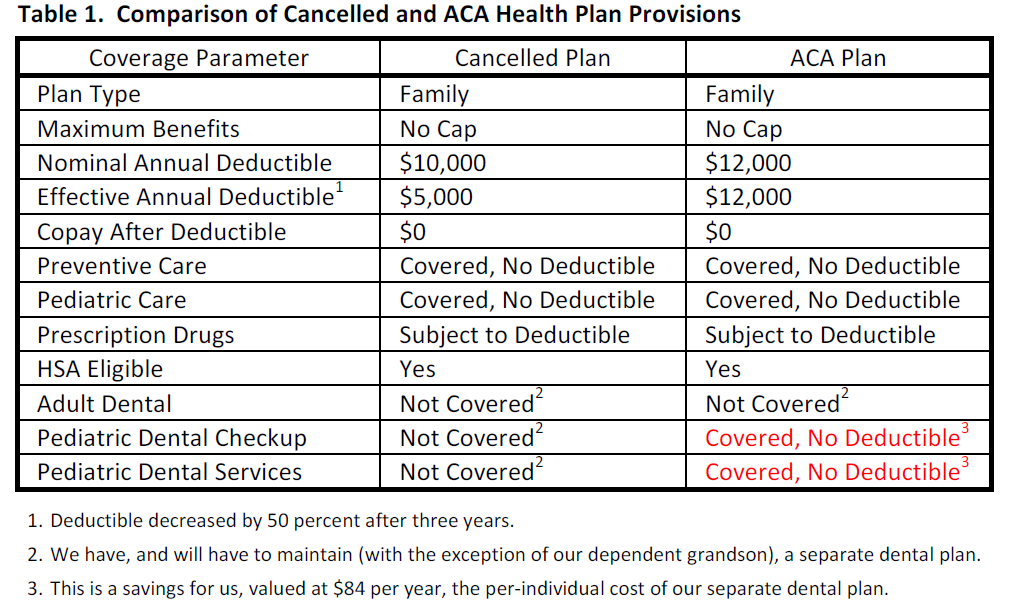
Ignoring premiums (for now), it’s pretty clear that the coverages are quite similar although the ACA plan has much higher deductibles. The annual deductible for the ACA plan is $12,000, as compared to the nominal deductible of $10,000 for the cancelled plan. However, the cancelled plan also included a “decreasing deductible” feature that is not included in the ACA plan, so the effective comparison is actually $12,000 for the new plan versus $5,000 for the cancelled plan (reflecting an earned benefit of $5,000 for not exceeding the cancelled plan deductible for three consecutive years). Thus, regardless of premium differences, the ACA plan costs substantially more in terms of deductible and provides no effective difference in coverage. Note that other ACA plans provide essentially equivalent coverage, but offer lower deductibles (in return for higher premiums).
Aside #2. Why does anybody buy a high deductible health care plan? The short answer is money. As an engineer, I evaluate everything, and health insurance is no exception. Each year (prior to the ACA), I would evaluate a menu of available plans in terms of premium dollars versus deductible and select the most cost effective option. Generally, if one does not have routine significant medical expenses, high deductible plans pay for themselves rather quickly in terms of premium savings (i.e., the money saved through lower premiums quickly adds up to the difference in plan deductibles). So if you are a healthy family without continuing medical needs, the high deductible plans make a lot of sense. Of course, it was not always this way as lower deductible plans used to be more affordable. But, rising health plan premiums pushed families such as mine into higher and higher deducible plans over time. But a high deductible plan is not equivalent to a bad health plan. Moreover, as indicated above, the ACA is, if anything, accelerating the movement toward even higher deductible plans. For those that have the luxury of employer‑provided health plans this may be somewhat eye-opening, but this is the world those of us in the self‑employed sector (who pay 100 percent of health care premiums out‑of‑pocket) have been living in for some time.
Aside #3. Under a provision of the ACA, actually going about my normal routine and evaluating available health plans annually, led directly to the “non‑grandfathered” nature of my pre‑ACA plan. By finding and joining a more cost effective individual market health plan in 2012, I triggered an ACA provision that states that individual market participants that enroll in any individual market plan after March 23, 2010 (the day the ACA was signed into law) cannot be considered to have enrolled in a grandfathered plan. A grandfathered plan is one that can continue indefinitely in tandem with the ACA, while a non‑grandfathered plan cannot. Apparently, the drafters of the ACA either didn’t realize that some people do not have employer‑sponsored health coverage and therefore actually shop for insurance (we used to call that competition in America) or possibly counted specifically on that fact to phase the pre-existing individual market into the ACA marketplace. I will never know. I do, however, know that this act of annual economic evaluation led directly to the inability of my pre‑ACA insurer to continue offering my pre‑ACA plan in Maryland after December 31, 2014.
Back Once Again to Our Story. Premiums, so how do they stack up? Table 2 compares the premiums and deductibles for my cancelled 2014 health plan to the same parameters of the cheapest ACA plan available on the Maryland ACA Marketplace for 2015.
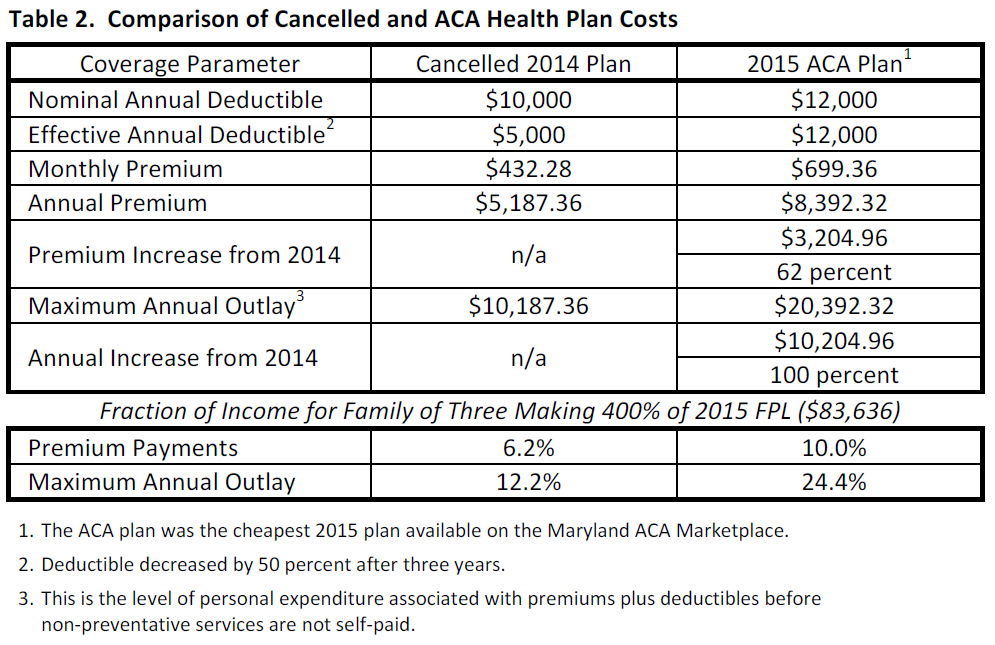
As indicated, the annual premium for my cancelled plan was $5,187, while that for the cheapest ACA plan was $8,392; a net increase in premiums of $3,205 per year (62 percent). The annual deductible for the ACA plan was $12,000, as compared to the effective deductible of $5,000 for the cancelled plan. Therefore, the net financial loss for 2015 under the ACA plan would be $3,205 plus every dollar up to $7,000 for medical expenses exceeding $5,000, or somewhere between $3,205 and $10,205. This loss would be compounded each and every year after 2015. Finally, the table depicts how these annual outlays would affect a family that is just over the threshold for ACA subsidies (i.e., a family with an income of at least four times the federal poverty level). Under the cancelled plan, that family would expend about 6 percent of their income on premiums and a maximum of about 12 percent on premiums plus deductibles. Under the cheapest ACA plan, the premium load would increase to 10 percent and the maximum outlay load to just under a quarter of annual income. In effect, the minimum annual outlays under the ACA plan are about equal to the maximum annual outlays under the cancelled plan.
How can this be? What about all the savings from folks no longer using emergency rooms as their primary care facilities and all the new premium dollars from all the previously uncovered young (and old) being forced into the ACA? Well there’s not much I can say with certainty about either, but if there are any emergency room savings, they can’t be too substantial given the ACA plan premiums. What I can say with certainty is that our pre-ACA plan was medically underwritten (i.e., priced in accordance with the medical risk we posed), so the difference in premiums between the pre-ACA and ACA plans represents the minimum level of subsidies that the ACA plan is allocating to participants outside my family. Moreover, the annual premium for the ACA plan referenced above for an individual less than 30 years of age was $1,552.68. Thus, the “excess” premium associated with the cheapest ACA plan for my family is equivalent to fully funding an insurance plan for two under 30 year old individuals. When considered in conjunction with the more than doubling of the plan deductible, which further reduces the payout risk of the ACA plan, it is quite clear that the weight of the ACA is not falling on the young, but on the older healthy segment of society.
Plan B. Under another of the various “fixes” implemented when it became apparent that the “you can keep ‘em if you like ‘em” health plans were actually going to be cancelled under the ACA, individuals with cancelled plans were allowed two alternatives to purchasing a “standard” ACA plan. Such individuals could purchase so‑called catastrophic coverage that is otherwise only available to those under 30 years of age, or they could apply for a coverage exemption. Good luck with the catastrophic coverage option. After spending (literally) hours (excluding the multiple 45 minute hold times typical during the 2015 enrollment period) educating general ACA Marketplace phone representatives, Marketplace‑recommended health insurance “navigators,” and representatives of actual health plan providers of my right to purchase such coverage, not a single person could inform me of what the premiums would be for such plan. Calling the federal marketplace was fruitless because as soon as one mentions Maryland (or any other state operating their own ACA Marketplace), right back to the state you go. In the end, I had to abandon this option as there was simply no way to access such a plan. Truly abysmal performance, yet by all accounts the marketplace was working admirably. Perhaps that is because there is no way to indicate that it is not. There is no complaint mechanism, either by phone or e‑mail, and it is impossible to speak with anyone above the level of the person answering the phone at the marketplace call center. Each phone call to the marketplace required at least a 30 minute hold and a similar “dead” time speaking with the “latest” representative going over the same information that was discussed with another representative on a previous call. The amount of time wasted dealing with a marketplace that by all reports was operating both admirably and efficiently is staggering. Self‑reporting of efficiency is obviously quite effective.
The Cost Effective Solution for 2015. As perverse as it sounds, the cost effective solution was to simply elect not to purchase an ACA plan. As an individual with a cancelled non‑ACA plan, I applied for and received an exemption for 2015. Instead of accepting what essentially amounted to a multi-thousand dollar tax increase in disguise, my family now rolls the dice as uninsureds; casualties of the ACA. Risky … you bet. But after weighing our options and considering our past medical expenses, it simply made more economic sense for us to accept that risk and put a premium‑equivalent amount of money aside each month to establish a working “self insurance” fund. We would essentially be self insuring up to a minimum of $20,000 annually under the ACA anyway, so our risk is limited solely to catastrophic potential. Not that such is insignificant, but a risk essentially forced on us as “acceptable” for 2015. Given that I write this in early May of 2016, it is clear that the 2015 risk paid off, but what is our long term solution? The issues leading up to our 2016 decision‑making are discussed in (probably too much detail) beginning with Part 3.
Posted May 8, 2016Questions or comments can be sent to aca@meszler.com