
(Part 13 of ?): Rate Requests for 2018 ACA Plans
June 2017. Hard to believe that any of this can still be done with a straight face. In May, CareFirst BlueChoice, Inc. (hereafter CareFirst), the largest insurer in Maryland, requested a rate increase for 2018 of 54 percent (excluding age effects, 58 percent with age effects) for their cheapest available individual market (Bronze) plan. Given that the requested premiums for the cheapest available plan are beyond absurdity, I am no longer going to even wade though the requests for other available (Silver and Gold) plans. The issues have not changed from those presented in the previous parts of this saga. Instead, I am simply going to post the comments I provided on the rate request to the Maryland Insurance Administration (via letter dated June 20, 2017). Hopefully they speak for themselves.
June 20, 2017
Alfred W. Redmer Jr.
Commissioner
Maryland Insurance Administration
200 St. Paul Place, Suite 2700
Baltimore, Maryland 21202
Dear Commissioner Redmer,
Why continue to comment? For the first time since my pre ACA insurance was cancelled at the end of 2014, I seriously considered not addressing the requested individual market rate increases in any way. What’s the point? The public portion of the process is pro forma. No responses to comments will be prepared and no change in MIA review findings will result. As I have done in the past, I could spend hours dissecting and identifying weaknesses in the rate filing documents, only to be informed that the included information is incomplete or outdated. The problems associated with the individual health insurance market go much deeper than identifying and weeding out calculation errors or determining whether an assumed factor should be X or Y. Only a complete and thorough overhaul will bring relief. That will not come of this review. So why bother?
One reason only. To continue to show the face of the oft-cited enemy; the reason the market is a disaster; the conscientious objector; the cast aside. To speak in the only forum in which one cannot be blindly ignored (and for that alone I sincerely thank the MIA). To let people know “we” are still around, and to perhaps enlighten a few souls as to why we feel like we have been incorrectly maligned and deemed expendable.
As you may recall, I am a 59 year old self-employed engineer. I have run my own company for nearly 15 years. Excepting the last three, I have had health insurance every year of my life. Since the cancellation of my pre-ACA policy at the end of 2014, I, my 60 year old wife, and my 5 year old grandson have been uninsured. I have analyzed ACA issues in detail, provided detailed letters of comment to all of my elected representatives, and participated in these rate review processes annually. From an accomplishments standpoint, the time spent has been essentially wasted. No one is interested in the fate of the cast offs. We do not constitute a sufficient population to merit attention, save as fodder for self-serving political rhetoric. We may be ignored, but we do exist, and we understand better that anyone else exactly what is happening in the individual insurance market.
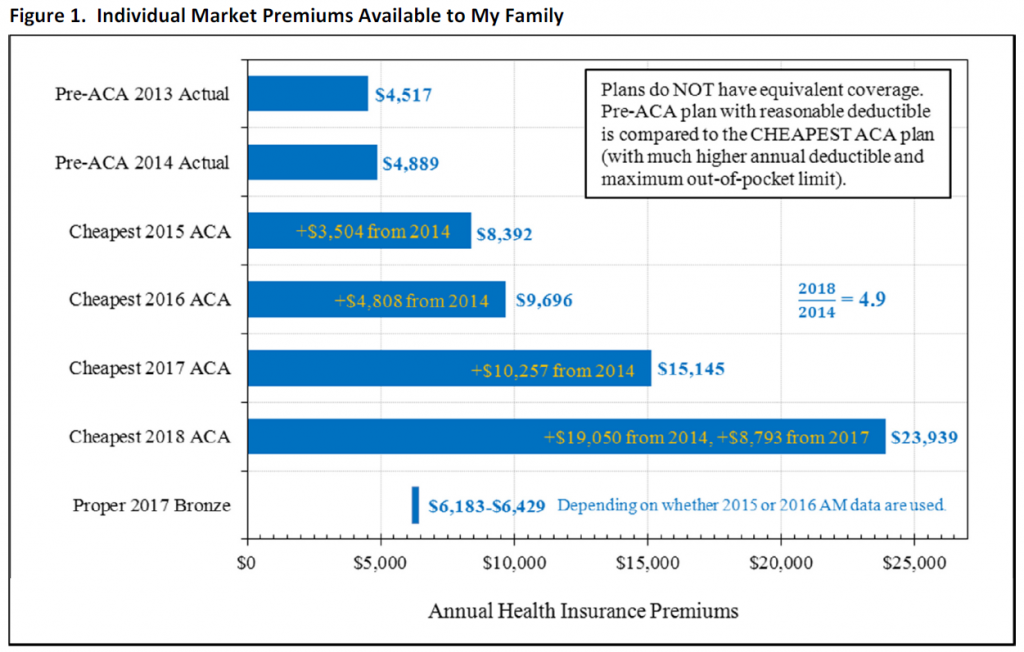
To provide context for these comments, Figure 1 summarizes the impacts of the ACA on the plans available to my family. Keep in mind that the presented data are for the cheapest ACA (Bronze level) plans, currently carrying an annual deductible of $13,100; plans that folks outside the individual market probably wouldn’t even consider viable. As indicated, the 2018 rates, if approved, would put the premiums for my family at just under five times those of our 2014 pre-ACA plan; equal to the full time annual pre-tax earnings of a worker making $11.50 an hour.
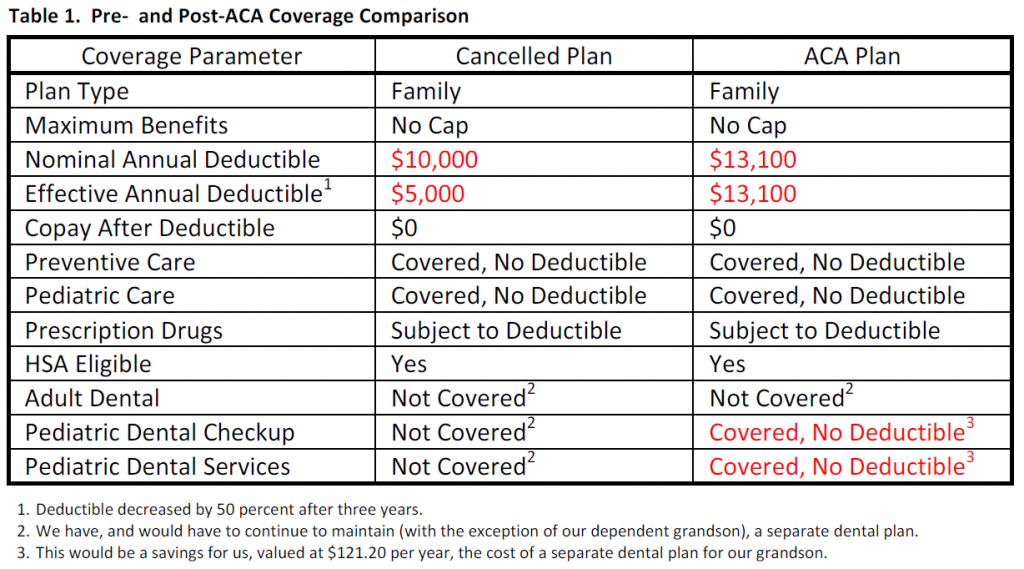
I know, I know … but Meszler, your pre-ACA plan was a joke, right? Surely you were taken in by the sellers of junk policies. Table 1 provides a basic coverage comparison. I know that you understand that not all pre-ACA policies were junk, but I include this information in case this material finds its way into the hands of those who dismiss the entire pre-ACA individual market as a scam for the easily deceived.
Realize also that I provide these data not because I expect anything to change — we are well past the point of no return and way into the realm of the absurd — but rather to provide an actual set of real world data that may help some interested few to cut through the rhetoric and see the real life implications of what is happening. Quite frankly, at this point there is a morbid fascination with observing just how far afield this market can go before even the rhetoric fails to mask reality. I would also add that in response to a general lack of interest in actually addressing issues faced by families such as mine, I have memorialized my experience under the ACA online at meszler.com/ACAinfo. I will be adding this letter to that archive.
Since dealing in the minutiae of this process is not productive, I would like to focus on the foundational weaknesses of the individual market, some of the more infuriating rationalizations bandied about by market supporters, and offer suggestions for potential changes. First, we have a market for the self-employed and unemployed designed and implemented by government and large-employer representatives. Since the health insurance premiums of such individuals are generally subsidized, it is unlikely that they can personally understand the full effects of their decisions on those who do not receive such subsidies (even if they have the best of intentions). I’m sure more than a few would object if the establishment of the compensation and benefit packages for government and large employers was delegated to the self-employed. Yet there appears to be no concern with a program that solely affects the compensation and benefits of the self-employed being designed and administered without any self-employed participation. Moreover, the self-employed are then subjected to the rationalizations of that same great majority of the country not affected by the program they seek to defend. Representation has been deemed a prerequisite for taxation since the first rumblings of this country, yet the self-employed have not a single seat at the table (either during the passage of the ACA or in current deliberations for a successor program).
What could go wrong when a plan basically maintains the status quo for government and large-employer markets and creates a separate stand-alone market for all others; the self-employed and the unemployed? Since many individuals in this cohort may be in this position precisely because they have health issues that preclude other employment, is it any wonder that premiums in this sector are skyrocketing when the budget must be balanced solely within the sector. These people are your neighbors, your friends, your relatives. If the country truly believes they should have access to the same health coverage as anyone else, why restrict the risk pool and associated budgetary impacts to those outside the government and large employer sectors. Everyone needs to step up to the plate.
Why a separate market for the self-employed? The obvious answer is to maintain the large employer (including government) health care market with minimal disruption; essentially isolating the bulk of ACA impacts in the smaller individual and small business markets. The net effect is that the major burden associated with the influx of the newly insured is borne by a relatively small number of rate payers. Put yourself in self-employed shoes the next time you hear the throwaway claim that individual rates are not all that important since they only affect a small percentage of people. That may be great comfort to those relatively unaffected in the large employer market, but it’s a major insult to those forced to bear the brunt of the ACA changes.
Equally dismissive is the oft-used argument that healthy people should not be shocked that they are subsidizing the unhealthy because “that’s how insurance works.” We can certainly debate whether subsidies and at what level might be appropriate, but ignoring risk is not how insurance works in my world. Have a few accidents and see if your car insurance rates stay the same as those who do not; have a fire and see if your homeowners rates are as low as those of your neighbors; see if your high cholesterol will get you the same life insurance rates as those with low cholesterol. All insurance policies that I own carry rates based on risk. Yes, we spread the risk, but we also adjust rates in accordance with individual risk. That is how insurance works in my world, despite assertions to the contrary.
We’d be all set if only the penalties for noncompliance were higher! Yup, that’s it. If we just make the stick bigger, scofflaws like me will have no choice but to join. Another great argument put forth by those not forced to participate in the individual market. Let’s not try to actually fix the problems, let’s just inflict more pain on those who recoil. No one my age wants to be without health insurance. The ACA forced at least one family out of the market and I have to live with that decision each and every day. The funds that don’t go to the ACA go into a private account that we use to self-insure. Prior to the ACA, the economic calculations that the self-employed undertake as a matter of routine were competitive from a risk standpoint and favored the purchasing health insurance, and we always did. That changed under the ACA. Do I want to purchase health insurance? Absolutely. Do I roll the dice every day that I don’t have it? Absolutely. Will I throw an obscene amount of money into a black hole to ease my mind? Absolutely not. It’s a cost benefit calculation and the numbers aren’t even close anymore. The designers can try to penalize me, but I am a man of who stands on his principles and I doubt they will find themselves successful. I’m not rebelling against the purchase of health insurance; I am rebelling against the purchase of poorly designed and cost ineffective health insurance. No penalty will change the economics of the underlying product.
Hey, go get a job that offers health insurance if you don’t like it. Sure, that’s a fair critique. Change the rules and then tell me to change in response. The self-employed have always had to purchase insurance on the open market. This is nothing new to us. What is new is the intervention into that market without any allowances for the self-employed to respond. In case it is not clear, the decision to become self-employed is not trivial. The self-employed must pay all business expenses while getting no paid sick leave, no paid vacation, no paid family leave, no paid holidays, no paid retirement, no matching retirement savings, no paid disability insurance, no unemployment insurance, no paid life insurance, no paid health insurance, and all while also having the privilege of paying both the employer and employee share of Social Security and Medicare taxes. And that’s fine, no one forces anyone to become self-employed and we all make the decision to do so with eyes wide open. But for anyone that started their own business before 2015 or so, ACA premiums are an expense introduced after the decision to self-employ was in the rear view mirror and for many of us, well out of sight. The ACA premiums are a disruptive step change — larger in magnitude than any of the previously listed expenditures — that could not possibly have been anticipated, and the self-employed do not have the market power to spread the disruption over a wide client base. Imagine being told that your salary was going to be reduced by $20,000 every year going forward. Yup, you could move on, but I suspect you’d get mighty irate first. And of course, the job market for 60 year olds is booming, so it’s all trivial. Yet fear not, the self-employed will continue to fund the health insurance subsidies of large-employer and government health plans though our tax and market consumption dollars.
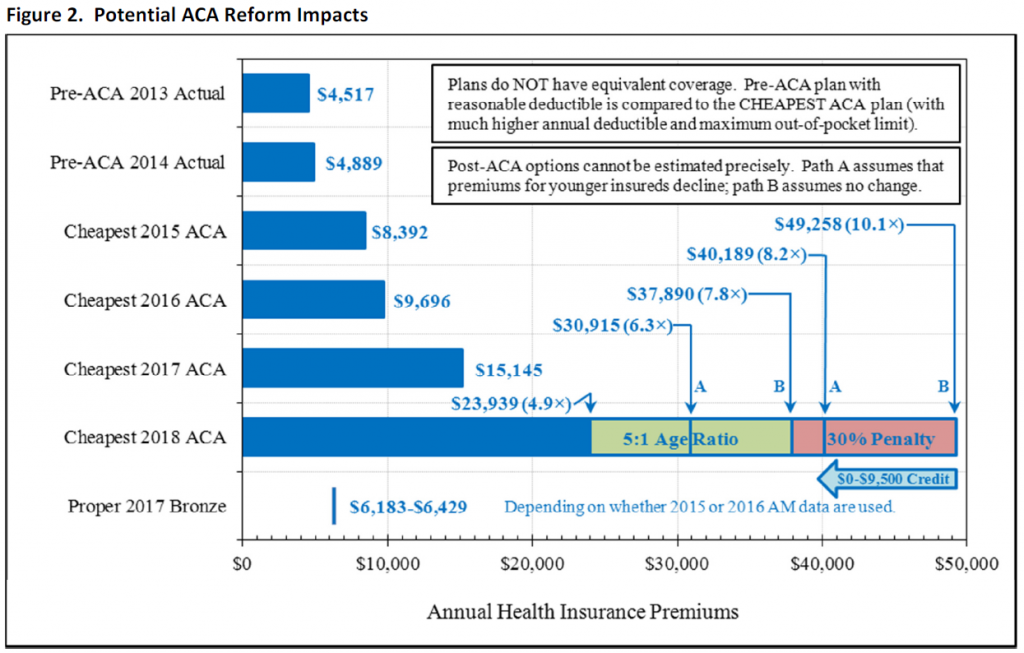
No worries, the ACA deconstructors are in power, all will be well. How could things not possibly get better? Well, apparently the deep thinkers continue to believe there is a vast untapped pool of young people just chomping at the bit to make the system sound, and that the key to leveraging this pool is to skew plan premiums even more heavily to the older end of the spectrum. As currently passed by the House, the ACA reform plan would change the current allowable premium limits for older Americans from three times the premiums for younger Americans to five times those same premiums. Additionally, the reform plan would do away with ACA non-participation penalties and substitute a 30 percent premium penalty. Figure 2 shows the potential impacts of such measures on a family such as mine with two age 60ish adults and one child. As indicated, the 5:1 premium allowance could raise rates by an additional $7,000-$14,000 annually; the lower figure assuming that rates for younger Americans actually drop while the higher figure assumes they do not. These increases do not include potential credits of up to $9,500 for a family such as mine, but these credits decline at higher (but still modest) incomes so their effect will vary. To the best of my knowledge, large-employer and government health insurance subsidies are not income dependent. The 30 percent non-continuity penalty would add another $9,000-$11,500, so that the plan premiums for a family such as mine could range from $40,000-$49,000 annually (for a plan with a $13,100 annual deductible) if no credits apply, or $31,000-$40,000 if full credits apply. In any case, the premiums would be substantially higher than the already ridiculous premiums being proposed for 2018. It should go without saying that such a well thought out plan, once again designed without the participation of the self-employed individuals mainly affected, does not have me waiting for redemption. The only debate in the District concerns Medicaid; the deep thinkers are totally out of step with those taxpayers they purport to represent.
So with all the debate and all the assertions that if the healthy and young would just sign up, we’d be all set, why has no one defined what the actual premium changes would be under such conditions? Legislators and insurers have all the data needed; the demographic data, the premium data. What is the impact of insuring everybody? If I threw $25,000 a year into the kitty and made no claims, that would equate to a premium reduction of 12 cents per year per insured member if the Universal Rate Review Template data (combined CareFirst, Kaiser, and Evergreen data) on member population is correct. Of course, that impact would drop proportionally if premiums actually declined in response. How many families like mine are there? Since (at a 3:1 premium ratio) it would take six young people to equal the financial impact of the two adults in my family, are there enough non-participants to really make a difference?
According to the Kaiser Family Foundation, there were about 365,000 uninsured individuals in Maryland in 2016. [footnote 1] Of these, nearly 40 percent were eligible for Medicaid or financial assistance, so they cannot bring down market premiums. Most of the remainder are either non-citizens or eligible for employer-based insurance, leaving about 50,000 scofflaws; uninsured individuals not eligible for financial assistance due to income, and thus available to bring premiums down. This equates to 25,000 two individual families (ignoring for convenience my grandson and his relatively minor premiums). If I assume half of these are equivalent to mine in terms of age, the total premium impact if all purchased insurance and made no claims would be about $1,250 per member per year. That same impact would require 75,000 young people, so this level of impact spans a range of 25,000 to 75,000 new plan purchasers, a range with a midpoint equal to the estimated 50,000 uninsured individuals not eligible for financial assistance. While $1,250 per year is not insignificant, it is minor compared to annual individual premiums exceeding $10,000 annually for age 60 individuals. Moreover, this benefit assumes that none of these individuals make claims. As such, it reflects the maximum impact that 100 percent participation can have on the market. It is, therefore, quite clear that the premium problems in the individual market cannot be laid at the feet of those who choose not to participate. I challenge those who claim otherwise to show supporting calculations prior to advancing such claims in the future.
Note also that the data reported on the last two CareFirst Universal Rate Review Templates shows a 1.5 percent decline in plan members, but an 11 percent increase in incurred claims per member. This shows directly that there is considerably more at work than participation rates (as claims per member would be expected to rise by only 1.5 percent if all those leaving the market were zero-claim healthy individuals). If society wants to point the finger at scofflaws like me as the source of the individual market premium problem, then let’s see the numbers. Show me the data. Better yet, hire me to look the data. Happy to do it. All the reporting citing penalties and surcharges as the path to a sound market, and not one analysis of readily available industry data to support the assertion. Pure rhetoric; the silence with regard to actual supporting data is deafening.
So, what is the solution? Certainly the pre-ACA system, while appealing to me from a selfish standpoint is not palatable to those who found themselves on the losing end of that proposition (as I do here). I can see and understand that. Any solution should start with all affected parties having a seat at the design table, especially the self-employed if an individual market is to be retained (and the basis for such retention is not at all clear). Expecting those not affected by the market to understand, let alone fix it is absurd. Some type of control or pay-as-you-go system needs to be imposed on those not paying or paying very little for their insurance (i.e., Medicaid and highly subsidized individual market consumers). I have shown in analyses conducted in previous years that the claim activity of such individuals is significantly greater than that of non-subsidized payers. Such data are readily available to the provider and regulatory community for further, more robust analysis, but it does not require much thought to figure out that if we all have to buy car maintenance plans and I offer you a free plan with no copays that you are likely to have your car in for inspection as often as desired, whether it really needs service or not. This control need not be punishing, but of sufficient magnitude to ensure that a calculation is required before accessing service.
Major concessions are also needed with regard to provider fees. Insurance providers have no real incentive to control costs when they can simply roll losses into an annual rate review process such as this. Moreover, 20 cents of every dollar of rate increase goes not toward paying claims, but toward internal costs that largely should be fixed. Insurance administrative costs should be decoupled from claim activity and subject to a separate review process, eliminating any administrative budget windfall potential from claim-based reviews.
The medical community itself needs to step up, and step up big. For obvious reasons, this community is a big backer of health care expansion. They have benefited from this expansion, a mandated market expansion, without a single cost containment requirement or concession. When the cost of system overuse, excessive testing, and overmedication can be passed right back to the consumer in the form of higher premiums, there is absolutely no incentive to control costs. The only incentive is one of utilization (and cost) maximization. I assume that I am not the only one that sees the incredible expansion of hospital and other medical delivery facilities. There is clearly no shortage of funds on the health care provider side of the equation. Surely I need not point out the absurd price of pharmaceuticals and the perverse incentive to overprescribe. Look no further than a provider induced opioid epidemic that the industry can now use as a rationale for rate payer funded treatment. Quite the racket. If there is going to be a mandated market, then all stakeholders need to be equal participants, with equal incentive to maximize economic and health efficiency.
Additionally, there has to be some recognition and allowance for the fact that not all people are the same. Behavior varies. Some run to the doctor for a common cold, some go only as a last resort. It is one thing to have a market to spread the risks of accidents and catastrophic illness, it is quite another to have the actions of the one philosophical group subsidized by the inactions of another. If we’re going to mandate coverage then a two-tiered system seems much more appropriate. Such a system could be built on a truly catastrophic base program, designed to provide coverage for serious accidents and catastrophic illness. This program would come with a high, but reasonable deductible and would provide coverage against those conditions most likely to devastate financially. More routine procedures could be covered under a second tier program, ideally à la carte in nature. Such an approach would allow for separation between services everyone would deem necessary and those subject to more personal decision-making.
Finally, while less important here than in the Medicare market, this country needs to have a serious (rhetoric-free) end of life discussion. Lying in a bed medicated to the gills for an extra two months is not prolonged life, it is prolonged (and in my opinion inhumane) death. Some of us have no intention of exiting this world full of tubes and covered with bedsores. No one has to agree with my opinion, but somewhere along the line we have become children unable or unwilling to speak of the natural order. I am stunned by this childishness, but then again it is consistent with the level of discourse on any number of issues. The mere mention of “death panels” sends shudders down the spine of the spineless. Why? It is the natural course of affairs. Without death, there is no life. A nation that will fall back on religious doctrine over the smallest of issues, will apparently delay progression from this world to the next at any cost. Has “no atheists in foxholes” been supplanted by “all doubters on deathbeds?” From personal experience with both my mother and mother-in-law, I have seen a medical community only too willing to steal the last days of two proud and stoic life-givers through the delivery of needless and torturous procedures when all that was appropriate and, most importantly, humane was comfort care. In both cases, it took considerable effort to convince medical providers that they could speak the truth and fear no legal retribution by bowing to the wishes of both great ladies. It is truly a sad state of affairs when one is not allowed control over their own fate. Maybe you feel differently, and that is your right. But there is no reason to ask either society as a whole, or in this case a small segment of society, to cover the costs of treatment that offers no more than an ultra-expensive short term delay in the inevitable. Such treatments should be discussed openly and offered under supplemental policies available to those who want them. Everybody wins without forcing their doctrine on everyone.
Right now the health care industry, including big pharma, insurance, and health care providers are spending about 800 million dollars annually to lobby the individuals charged with designing the health care system in this country. [footnote 2] It’s obvious whose interests are going to be at the top of the list as “our” representatives in the District formulate the next iteration of the greatest corporate money grab in the history of this country.
As things currently stand and as they appear to be devolving, I have come to terms with the fact that my family will live outside the health insurance marketplace until such time as we become eligible for Medicare. If we do not make it that far, we will live and we will die outside a system we had no say in designing. Other decision-makers have deemed that trading my family off against those more in need is acceptable. Maybe it is, maybe it isn’t; but any system that plays one against the other is flawed. I can only respond to the market that is forced upon me. I am not a man looking for a free ride. If I seek medical services I will pay, or I won’t seek. In my world, self-reliance, pride of responsibility, and fortitude are still virtues. In the world that now surrounds me, omega is alpha; both in rhetoric and action. Life, as defined by interests that I cannot understand, unfolds on a three inch screen. I find it truly sad. I am lost in such a world. I will stay in mine and ask only that the powers that be find a way to minimize intrusion.
Thank you for your time and consideration. I would like to promise that this will be the last set of comments from me that you will have to endure, but given the ever increasing absurdity of individual market issues and the proposed solutions thereto, I doubt I will be able to honor such a commitment. Best of luck carrying out your duties under this no win situation.
Respectfully,
/s/
Daniel J. Meszler
Meszler Engineering Services
906 Hamburg Drive
Abingdon, Maryland 21009
The White House
1600 Pennsylvania Avenue NW
Washington, D.C. 20500
Governor Larry Hogan
100 State Circle
Annapolis, Maryland 21401-1925
Benjamin L. Cardin
509 Hart Senate Office Building
Washington, D.C. 20510-2003
Chris Van Hollen
110 Hart Senate Office Building
Washington, D.C. 20510-2003
Andrew P. Harris, M.D.
1533 Longworth House Office Building
Washington, D.C. 20515
Footnotes:
- Garfield, R.; Damico, A.; Cox, C.; Claxton, G.; Levitt, L.; “Estimates of Eligibility for ACA Coverage among the Uninsured in 2016,” The Henry J. Kaiser Family Foundation, October 2016.
- Center for Responsive Politics, https://www.opensecrets.org/lobby/incdec.php, data downloaded on June 16, 2017.
That’s Where Things Stand. Hard to believe, but this saga just continues to get more and more absurd. If I can continue to ignore my desire to just throw up my hands and walk away, I will address whatever the next installment might be in Part 14.
Posted June 20, 2017Questions or comments can be sent to aca@meszler.com