
(Part 16 of ?): Requested Rates for 2019 ACA Plans
May 2018. Time for the annual fleecing. 2019 ACA plan rate requests were released in early May. No point in providing introductory comments anymore. How does one rationalize absurdity? I will simply post the contents of my summary letter to my “representatives,” intended solely to keep them informed of the fruits of their labors. I should note that the White House did actually respond to the letter, albeit with a rhetoric-laden missive laced with irony. So the fruits of my labor now include rhetoric from two White House administrations, while the health insurance fiasco rolls on. So much for success …
June 5, 2018
President Donald TrumpGovernor Larry Hogan
The White House100 State Circle
1600 Pennsylvania Avenue NWAnnapolis, Maryland 21401-1925
Washington, D.C. 20500
Benjamin L. CardinChris Van Hollen
509 Hart Senate Office Building110 Hart Senate Office Building
Washington, D.C. 20510-2003Washington, D.C. 20510-2003
Andrew P. Harris, M.D.
1533 Longworth House Office Building
Washington, D.C. 20515
Dear Insureds,
Here we are, another year, another massive rate increase request for the individual health insurance market. No sense wasting my time writing long expositions on what is wrong with the market or what might be done to provide much needed reform, your continuing silence and/or continuing inflammatory rhetoric more than adequately expose your lack of concern and, more importantly, lack of solution. I will simply depict the requested rates and leave you with a series of questions to consider (or more likely ignore).
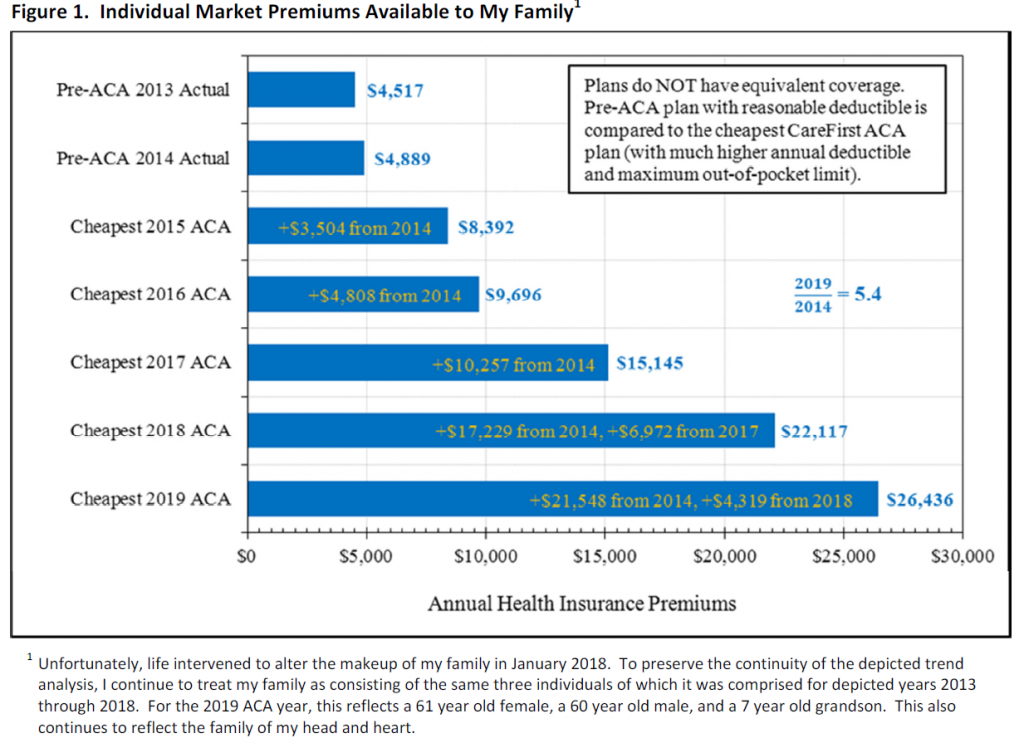
Figure 1 depicts the recently requested 2019 rates for the cheapest CareFirst BlueCross BlueShield (Maryland’s dominant insurer) ACA policy. When I wrote last with regard to the approved 2018 rates, there was a modestly cheaper plan from another insurer that I chose not to include in the figure in order to maintain statistical continuity. For 2019, that issue has gone away as the requested rates for that cheaper plan are now virtually identical to those of the cheapest CareFirst plan (the plans differ in cost by $277 per year; one percent). Requested 2019 rates are at more than five times those paid in 2014 for a better plan.
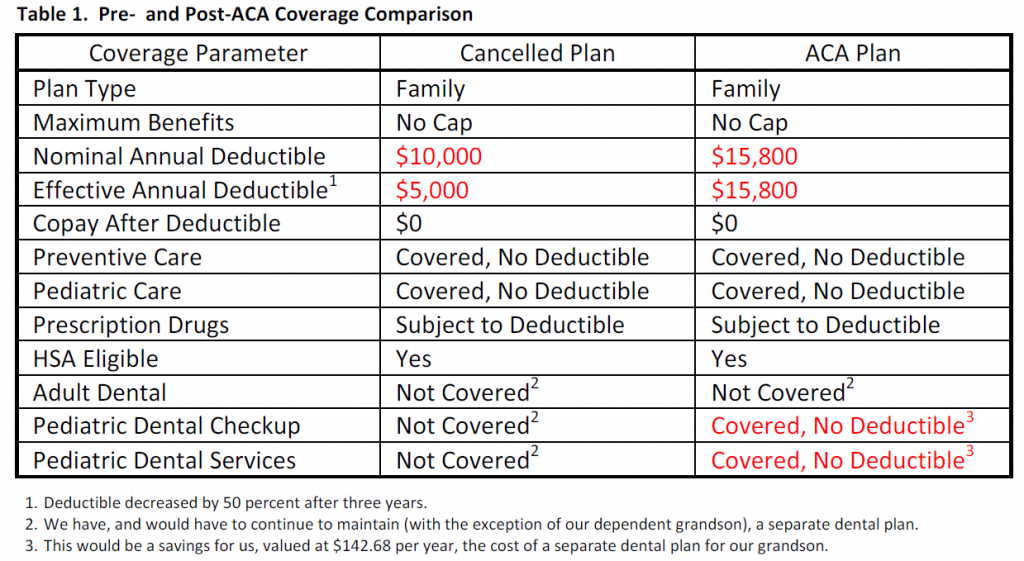
You might also notice (if you care) from Table 1, that the family deductible associated with the depicted 2019 plan has increased from $13,100 to $15,800. Premiums up by $4,300; deductible up by $2,700. What a deal! A family not receiving subsidies and incurring health problems racks up the first $42,000 (per year) out of pocket.
For a family of three, premium subsidies stop at an income of $83,120. For such a family, the cheapest plan premiums would consume 32 percent of pre-tax income. Premiums plus deductible would consume 51 percent.
Questions for you to ignore:
If all uninsured individuals like me were to purchase insurance, how much would the requested rates for 2019 decline? You have the data to make this calculation, but doing so would highlight the impotency of the false blame game and shine a bright light on the actual program flaws.
What are the time series statistics for claim dollars per individual, broken down by level of subsidy and cost sharing received? You have the data to make these calculations, but showing them would highlight the fact that the problem is basically one of runaway claims (facilitated as a dance between the insured and their unrestricted providers).
What is the basis for treating all “non-employer based” individuals as a homogeneous market? Is it not reasonable to think that some fraction of the “non-employer” population is in that situation precisely because of health and other lifestyle issues? There is no more of a connection between those comprising the individual market than there is between myself and Exxon. Yet you largely isolate large employers and government agencies from the effects of your market intervention; on what basis (other than the size of the affected voting population)?
What is the rationale for allowing medical and drug providers to charge differential fees? Does it cost a hospital or drug company more to provide the identical treatment or the identical prescription to an uninsured person than to an insured person? Why should the uninsured subsidize agreements reached between independent parties (insurers and medical service providers)?
What is the tipping point for you? At what point does the “for it or against it” rhetoric stop and the actual seeking of solutions begin? You have chosen to intervene in an existing market, and in response to resulting problems you have offered nothing but more inflammatory rhetoric and straw men (for years now). Attacking with an axe is no more beneficial than building with blinders.
How do your proposed solutions (if any) address the cost side of the equation, both in terms of cost per procedure and procedure count?
How do your proposed solutions address consumer behavioral differences, not just in terms of overall health differences, but in terms of differences in individual treatment thresholds? Should someone who “guts it out” be grouped (from an actuarial standpoint) with someone who seeks treatment for “every little thing?”
Now that states are being encouraged to intervene, what fraction of individuals on the Maryland commission considering the individual health insurance market is insured through that market? What fraction of those individuals (if any) receives no subsidies or cost sharing benefits?
What fraction of individuals on the Maryland commission considering the individual health insurance market are self-dealing representatives of health care entities benefiting from that market?
What fraction of individuals on the Maryland commission considering the individual health insurance market is insured through their employer or through taxpayer subsidies? What qualifications do such individuals have to walk in the shoes of those affected by the individual market?
These last few questions regarding the Maryland commission could just as easily be turned rearward and addressed to the federal committee that designed the same subject market a decade ago. The Maryland commission is targeted simply out of timeliness. In closing, I thank you for occupying a front row seat to the health care industry’s coup of the American economy. Until the next act in this sorry saga …
/s/
Daniel J. Meszler
Meszler Engineering Services
906 Hamburg Drive
Abingdon, Maryland 21009
Commissioner
Maryland Insurance Administration
200 St. Paul Place, Suite 2700
Baltimore, Maryland 21202
And On We Go. The next episode, if any, will be related in Part 17.
Posted July 22, 2018Questions or comments can be sent to aca@meszler.com