
(Part 14 of ?): Approved Rates for 2018 ACA Plans
September 2017. 2018 ACA plan rates for Maryland were approved on August 25, 2017. No sense wading through the issues any longer; they have not changed from those presented in the previous parts of this saga. Instead, I will continue to simply post the comments I send off to my “representatives” (in this case via letter dated September 14, 2017). Although there is no hope that rates will ever return to levels reasonable for those of us who choose not to live our lives in accordance with the whims of the “profit at any cost” medical establishment and the regulators that enable such behavior, I continue to believe that there is value in letting these parties know that their actions (and inactions) are not unnoticed.
September 14, 2017
President Donald TrumpGovernor Larry Hogan
The White House100 State Circle
1600 Pennsylvania Avenue NWAnnapolis, Maryland 21401-1925
Washington, D.C. 20500
Benjamin L. CardinChris Van Hollen
509 Hart Senate Office Building110 Hart Senate Office Building
Washington, D.C. 20510-2003Washington, D.C. 20510-2003
Andrew P. Harris, M.D.
1533 Longworth House Office Building
Washington, D.C. 20515
Dear Employees of the Citizens of the Maryland,
Not to worry, just a few facts this time. But first, let me thank you for your detailed responses and attention to the issues I have raised in previous correspondence. Without that attention, there might be real problems. Since those problems are now well under control, extended discussion is pointless. No need to waste either your time or mine, so just a basic update.
- Maryland health insurance rates for 2018 have been approved.
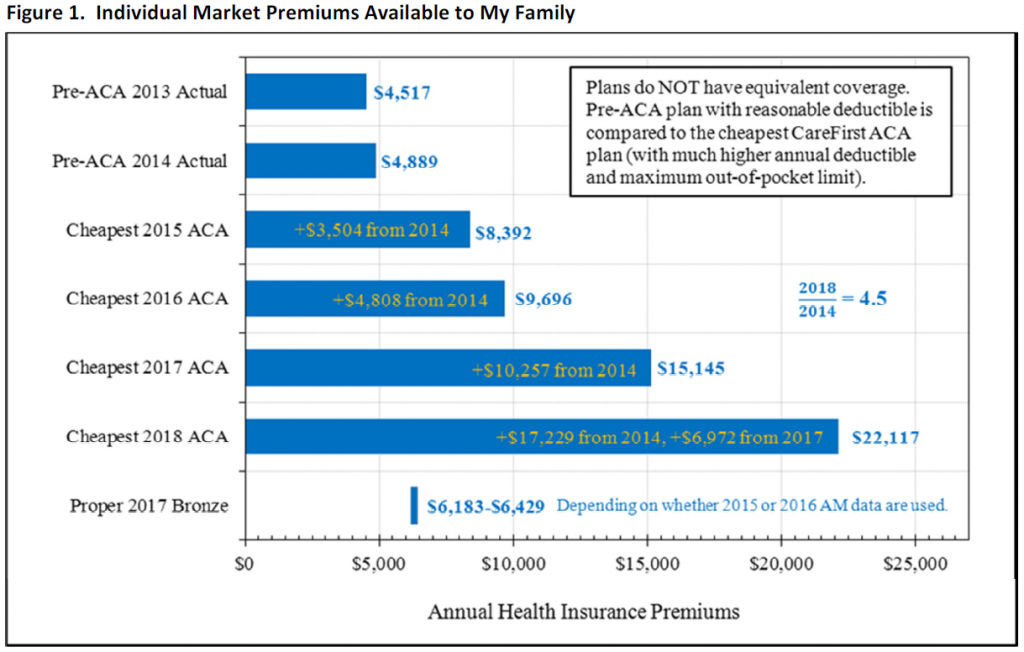
- Figure 1 shows comparison to pre-ACA rates.
- The rate increase alone for 2018 is larger than the entire pre-ACA premium.
- The rate for 2018 is 4.5 times pre-ACA rate.
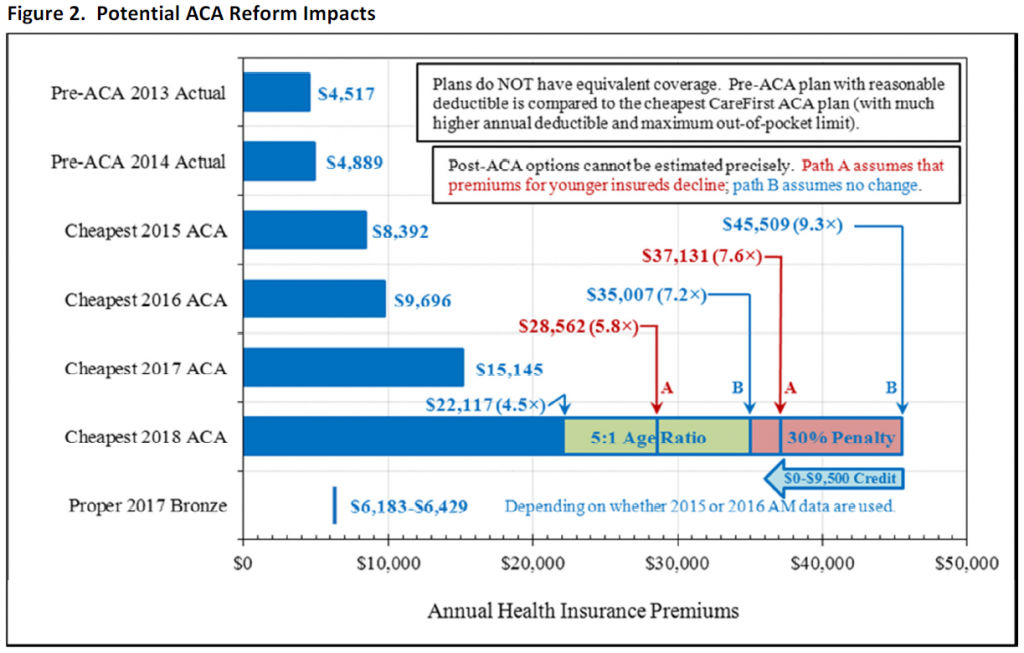
- The uber-brilliant proposed fix from the spring/summer is comatose at this time, but just in case some bright light decides to revive it, Figure 2 shows what that brain trust of a plan would do for my family (based on 2018 rates).
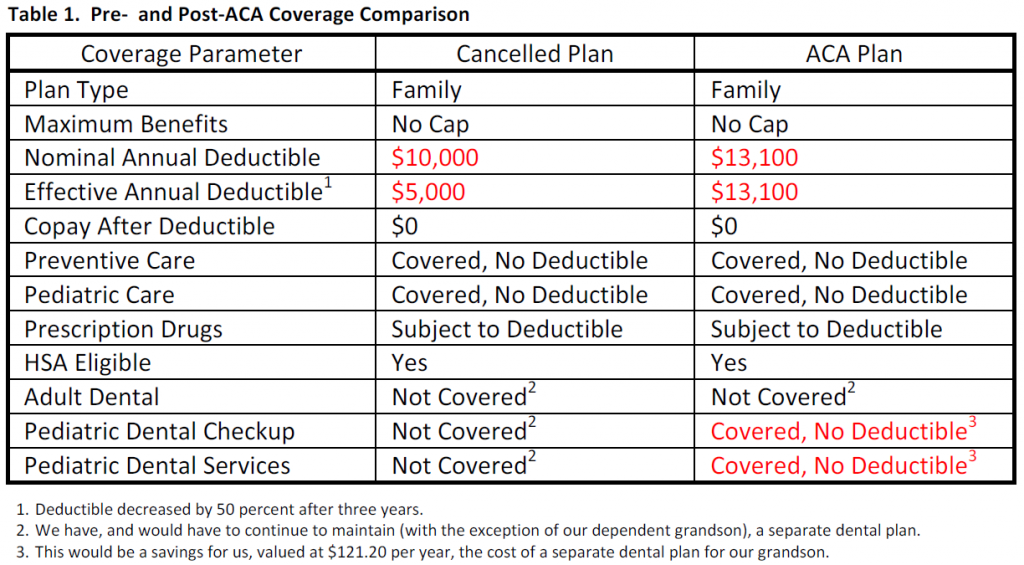
The one qualification I will expand upon is that the ACA plans presented in the included charts reflect the cheapest plans offered by CareFirst BlueCross BlueShield (CF), which holds a dominant market share in Maryland. Prior to 2017, the charted CF plan was the cheapest plan of any provider. That changed beginning in 2017, but not significantly. For 2018, the cheapest available plan (in terms of premiums) appears to be a Kaiser Permanente Bronze plan that would carry a premium for my family of $19,664, about 11 percent lower than the charted CF plan. However, the maximum out-of-pocket costs for the Kaiser plan are about 12 percent higher than the CF plan, so the net difference in premiums plus other out-of-pocket costs is small (2 percent). As a result, I elect to chart the more popular CF plan as it provides rate comparison continuity that is not possible by shifting plans from year to year. If the cheapest Kaiser plan was substituted for the charted CF plan, the $4,519 rate increase for 2018 would still be nearly as large as the entire pre-ACA premium and the ratio of 2018 premiums to 2014 premiums would still be 4.0. Either plan shows a quadrupling of premiums in four year period.
Please, do not concern yourselves with any of this. After all, it is a tough problem and we fully realize that pointing fingers at each other is exhausting. And, please, please do not recognize that establishing a mandated market that imposes no controls on either service providers or heavily subsidized consumers is nothing but a recipe for runaway costs. “Why not do five, no ten, no wait, twenty tests? And I will definitely need to see you on an ongoing basis. Please also see these specialists and take these medications.” After all, all the costs just get passed back to non-subsidized consumers in the form of ever increasing premiums. It’s the very definition of an out of control feedback loop. A loop that allows an industry to charge consumers to both create and treat an epidemic. Of course, it’s equally obvious to everyone that increasing non-compliance penalties will only serve to further strengthen the feedback signal, so I have no worries that any of you would propose such a solution. It’s a great gig if you can get it and we sure wouldn’t want to put any pressure on those political contributions from the insurance and health care lobbies. It absolutely has to be a great thing that the health care industry is so cash heavy that they can consume endless tracts of prime urban real estate constructing glorious gleaming monuments to your foresight. Ah, no matter, as the problems only affect the small segment of the unrepresented non-political class that you foisted this well thought out, everyone contributes, plan upon. Despite the fact that you have made medical insurance a choice between the payment of outrageous premiums to effectively self-insure and avoidance of those premiums to actually self-insure, you can rest assured that taxpayers will continue to support your 70 percent health insurance subsidies. I challenge you to propose a tax increase of one-tenth the size of this family budget-busting program. But no matter … carry on, point fingers, spew rhetoric … jobs well done!
While I would normally apologize for the oozing sarcasm, I see no reason to do so here. Your lack of consideration and concern is quite apparent, so I’ll treat the matter accordingly. After all, it’s not like you’re going to start paying attention now.
Until the Next Absurd Chapter,
/s/
Daniel J. Meszler
Meszler Engineering Services
906 Hamburg Drive
Abingdon, Maryland 21009
That’s All For Now. The next unscheduled installment, if any, will be in Part 15.
Posted September 14, 2017Questions or comments can be sent to aca@meszler.com