
(Part 15 of ?): Resistance is Futile
February 2018. In an effort to maintain the squeeze on unrepresented individual market insurance consumers, the Maryland legislature took up a bill to institute a state-level individual health insurance mandate during the 2018 legislative session (Senate Bill 1011, House Bill 1167). Of course the bill was as one sided as the federal Affordable Care Act, effectively asking individual consumers to fund without recourse the ever increasing expenditures of an out-of-control market. The Maryland Senate held a hearing on the proposed bill on February 21, 2018 and the following letter was submitted in opposition. Fortunately, the proposed legislation did not pass, but it will almost assuredly be resurrected in some form by those who continue to turn a blind eye to the fact that mandating participation in a fundamentally flawed system will not address the underlying flaws. Who knows what scapegoat folks will turn to once they do adopt an iron-clad mandate and increases in already out-of-control insurance rates continue unabated.
February 20, 2018
Maryland Senate Finance Committee
Miller Senate Office Building
11 Bladen Street
3 East Wing
Annapolis, Maryland 21401
Dear Members of the Senate Finance Committee,
Please accept these comments on proposed Senate Bill 1011, the “Protect Maryland Health Care Act of 2018.” While I would very much like to present the comments in person, I am, unfortunately, unable to detach myself from everyday responsibilities on such short notice (having found out about the bill only through an article in the February 20, 2018 edition of the Baltimore Sun). I would, however, be happy to discuss the various issues further at your convenience should there be any interest in doing so.
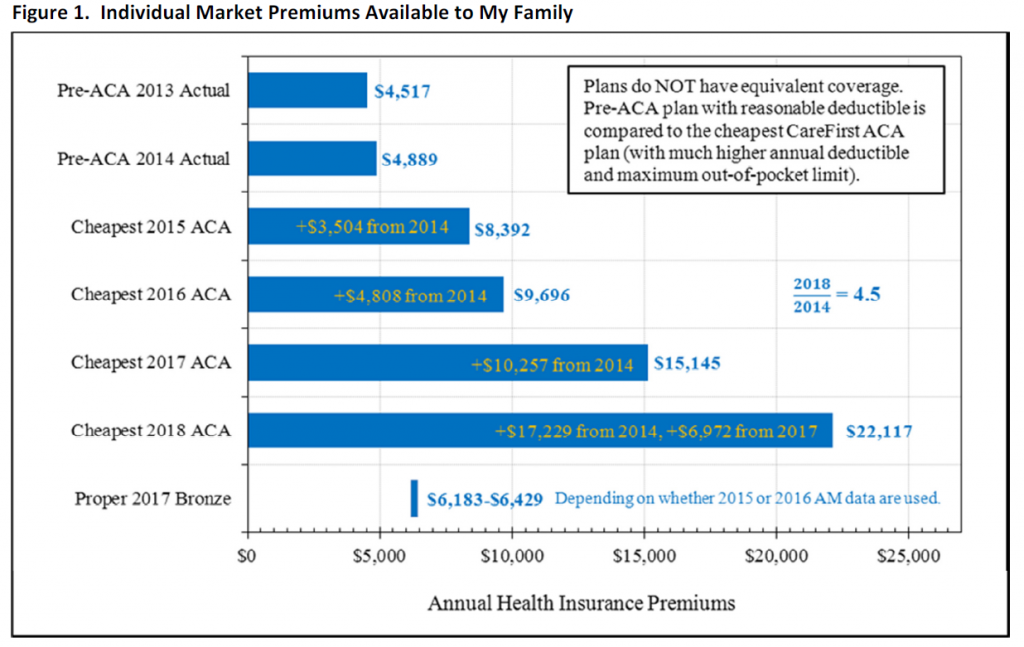
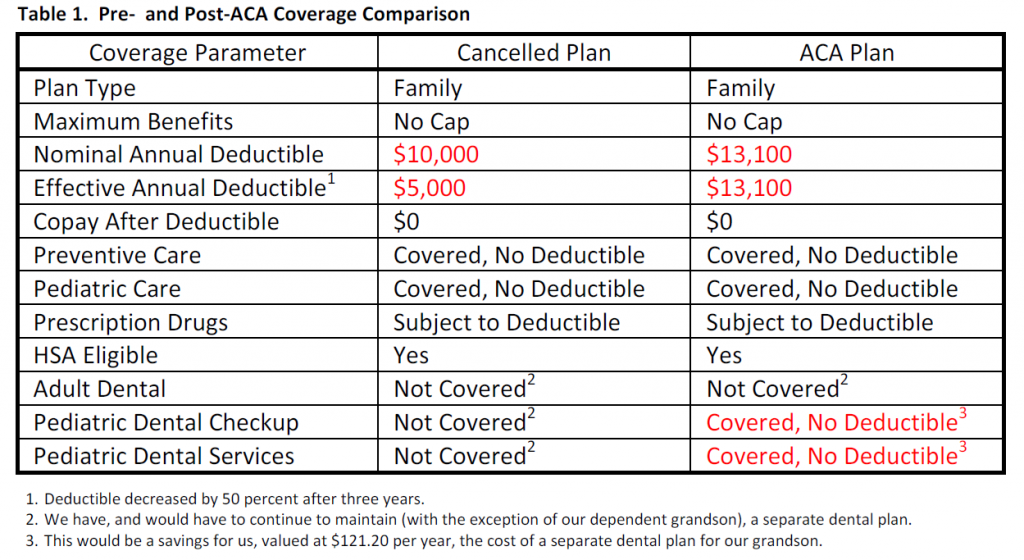
While I will try to be brief, this is not a subject that lends itself to brevity (or simplicity). To facilitate a fuller understanding of the setting in which SB1011 is introduced, I must provide an abridged review of at least my family’s experience with the individual health insurance market under the Affordable Care Act (ACA). My family participated in the individual market for over a decade from 2003 (when I started my own business) through 2014 (following which our health insurance was cancelled under provisions of the ACA). From 2015 through 2018, we have opted to self-insure due to the inequities of the ACA. The exclusive reason for this decision is the cost-benefit proposition of the ACA. Figure 1 shows the actual pre-ACA insurance premiums paid by my family and the actual post-ACA premiums available. Table 2 shows a basic comparison of pre- and post-ACA plan provisions. As you can see, the 2018 ACA premium is quadruple our 2014 pre-ACA premium. Moreover, as shown in Table 2, this premium increase has come bundled with a substantial increase in plan deductible. In effect, my family would pay the first $35,000 in health expenses in 2018 under the ACA (we do not qualify for premium support or cost sharing). In response, we elect to self-insure.
Dealing with the exemption process under the ACA is not easy, and while I would prefer to have health insurance, it was with some relief that it appeared that at least the annual frustration of having to document an exemption was at an end. Please understand that ACA plan premiums are so high at this point that all but the highest-salaried older individuals will quality for a financial exemption. Is this of comfort, absolutely not, but at least it saves affected individuals from the insult of being fined for a program they had no hand in creating. But along comes SB1011, which instead of focusing on addressing the flawed aspects of the ACA, seeks only to restore the penalty provisions of the program. Of course, it is always easier to simply stick it to the “invisible” consumer, but I would strongly encourage you to look at the aspects of the ACA that lead to the absurd premiums (and deductibles) and not simply pretend that it is some vast untapped pool of healthy scofflaws that is driving the observed trends. It is easy and convenient to assume that that is the case, but anyone who looks at the data can easily demonstrate otherwise. Ask yourself why you do not see health care providers and advocates walking in and showing you just how much plan premiums would decline if everyone subject to the individual market purchased health insurance. The reason you do not see such numbers is simple, the change would be minor for those already priced out of the program.
So, what is the solution? Certainly the pre-ACA system, while appealing to me from a selfish standpoint is not palatable to those who found themselves on the losing end of that proposition (as I do with the ACA). I can see and understand that. Any solution should start with all affected parties having a seat at the design table, especially the self-employed if an individual market is to be retained (and the basis for such retention is not at all clear). Expecting those not affected by the market to understand, let alone fix it is absurd. Equally absurd is expecting a health care industry that directly benefits from the additional services enabled by insurance expansion to construct an effective program design. I can certainly recommend that you require every citizen of Maryland to hire my services each and every year, but I’d hardly expect you to seriously consider such an obviously self-serving suggestion, let alone allow me to fashion the enabling program. Yet here you are, debating a “fix” to a program designed by individuals who are not subject to it and an industry that it directly benefits. All one needs to do is look back at Figure 1 to see what could possibly go wrong?
What is missing (and requires fixing) are controls on both users and providers. Designers of the ACA elected to intervene in an existing market, but intervened only on the consumer funding side of the economic equation. There is no recognition that all consumers are not the same, or that health care providers have no economic rationale to either limit usage or control cost. The health care industry received an unrestricted windfall and has [been] asked to contribute nothing for the mandated market.
Some type of control or pay-as-you-go system needs to be imposed on those not paying or paying very little for their insurance (i.e., Medicaid and highly subsidized individual market consumers). I have shown in analyses conducted in support of testimony at annual ACA rate review hearings that the claim activity of such individuals is significantly greater than that of non-subsidized payers. Such data are readily available to the provider and regulatory community for further, more robust analysis, but it does not require much thought to figure out that if we all have to buy car maintenance plans and I offer you a free plan with no copays that you are likely to have your car in for inspection as often as desired, whether it really needs service or not. This control need not be punishing, but of sufficient magnitude to ensure that a calculation is required before accessing service.
The hea[l]th care community itself needs to step up, and step up big. For obvious reasons, this community is a big backer of health care expansion. They have benefited from this expansion, a mandated market expansion, without a single cost containment requirement or concession. When the cost of system overuse, excessive testing, and overmedication can be passed right back to the consumer in the form of higher premiums, there is absolutely no incentive to control costs. The only incentive is one of utilization (and cost) maximization. Surely I am not the only one that sees the incredible expansion of hospital and other medical delivery facilities. There is clearly no shortage of funds on the health care provider side of the equation. I also need not point out the absurd price of pharmaceuticals and the perverse incentive to overprescribe. Look no further than a provider induced opioid epidemic that the industry can now use as a rationale for rate payer funded treatment. Quite the racket. If there is going to be a mandated market, then all stakeholders need to be equal participants, with equal incentive to maximize economic and health efficiency.
At a minimum, the health care community needs to establish one set of fees that are applicable to all users. Why am I, as a self-insured individual, subject to different fees than those assessed to an employer-based, or any other, insured? Does the service somehow cost more when performed on my behalf? If health care is to be transparent and fair, then costs should be based on market economics, not the subsidization of insurer-negotiated cost restrictions through the inflation of costs to others. The service is provided independent of insurance, so too should be the cost.
There has to be some recognition and allowance for the fact that not all people are the same. Behavior varies. Some run to the doctor for a common cold, some go only as a last resort. It is one thing to have a market to spread the risks of accidents and catastrophic illness, it is quite another to have the actions of the one philosophical group subsidized by the inactions of another. If we’re going to mandate coverage, then (at least) a two-tiered system seems much more appropriate. Such a system could be built on a truly catastrophic base program, designed to provide coverage for serious accidents and treatable catastrophic illness. This program would come with a high, but reasonable deductible and would provide coverage against those conditions most likely to devastate financially. More routine procedures could be covered under a second tier program, ideally à la carte in nature. Such an approach would allow for separation between services everyone would deem necessary and reasonable and those subject to more personal decision-making.
Finally, this country needs to have a serious (rhetoric-free) end-of-life discussion. Lying in a bed medicated to the gills for an extra two months is not prolonged life, it is prolonged (and in my opinion inhumane) death. Some of us have no intention of exiting this world full of tubes and covered with bedsores. One can disagree, but somewhere along the line we have become children unable or unwilling to speak of the natural order. I am stunned by this childishness, but then again it is consistent with the level of discourse on any number of issues. The mere mention of “death panels” sends shudders down the spine of the spineless. Why? It is the natural course of affairs. Without death, there is no life. From personal experience with both my mother and mother-in-law, and most recently with my beloved wife, I have seen a medical community only too willing to steal the last days of proud and stoic life-givers through the delivery of needless and torturous procedures when all that was appropriate and, most importantly, humane was comfort care. It takes considerable effort to convince medical providers that they can speak the truth and fear no legal retribution in discussing end-of-life options. It is truly a sad state of affairs when one is not allowed control over their own fate. Nothing is more personal, yet our society has made it virtually impossible to act in one’s personal interests at this most vulnerable time. Others have every right to feel differently, but there is no reason to ask either society as a whole, or in this case a small segment of society, to cover the costs of treatment that offers no more than an ultra-expensive short term delay in the inevitable. Such treatments should be discussed openly and offered under supplemental policies available to those who want them. Everybody wins without forcing their doctrine on everyone.
Right now the health care industry, including big pharma, insurance, and health care providers are spending about 800 million dollars annually to lobby the individuals charged with regulating the health care system in this country. [footnote 1] It’s obvious whose interests are going to be at the top of the list as you formulate health insurance policy in Maryland. I urge you to reject the blatant one-sidedness of this proposition and instead consider those consumers that are most affected by your decisions. If you are truly concerned about the availability of health care to Maryland’s citizenry, I urge you to step back from this bill and institute a program to review the health insurance system from top to bottom, and develop a plan that works for everybody; a plan that does not treat the self-employed as some distinct entity that can be regulated from afar. If you don’t have to live with the results, how can you possibly understand the implications of your actions? Do not restore a provision of a poorly designed federal program and expect some benefit that was not even observed federally. The problems run much deeper and cannot be fixed by sticking it to those individuals already harmed by the current state of the individual health insurance market. I urge you to reject SB1011.
Please note that I have tried to restrict and distill my comments in the interest of brevity. You can, however, find more detailed background on the ACA and how it has affected my family at www.meszler.com/ACAinfo. Thank you for your time and consideration. I can be reached at 410-569-0599 or at dan@meszler.com if you desire any additional information.
Respectfully,
/s/
Daniel J. Meszler
Meszler Engineering Services
906 Hamburg Drive
Abingdon, Maryland 21009
Footnotes:
- Center for Responsive Politics, https://www.opensecrets.org/lobby/incdec.php, data downloaded on June 16, 2017.
Can’t Get Enough? The fun continues in Part 16.
Posted July 22, 2018Questions or comments can be sent to aca@meszler.com