
(Part 4 of ?): Rolling into (and Through) the 2016 Enrollment Period
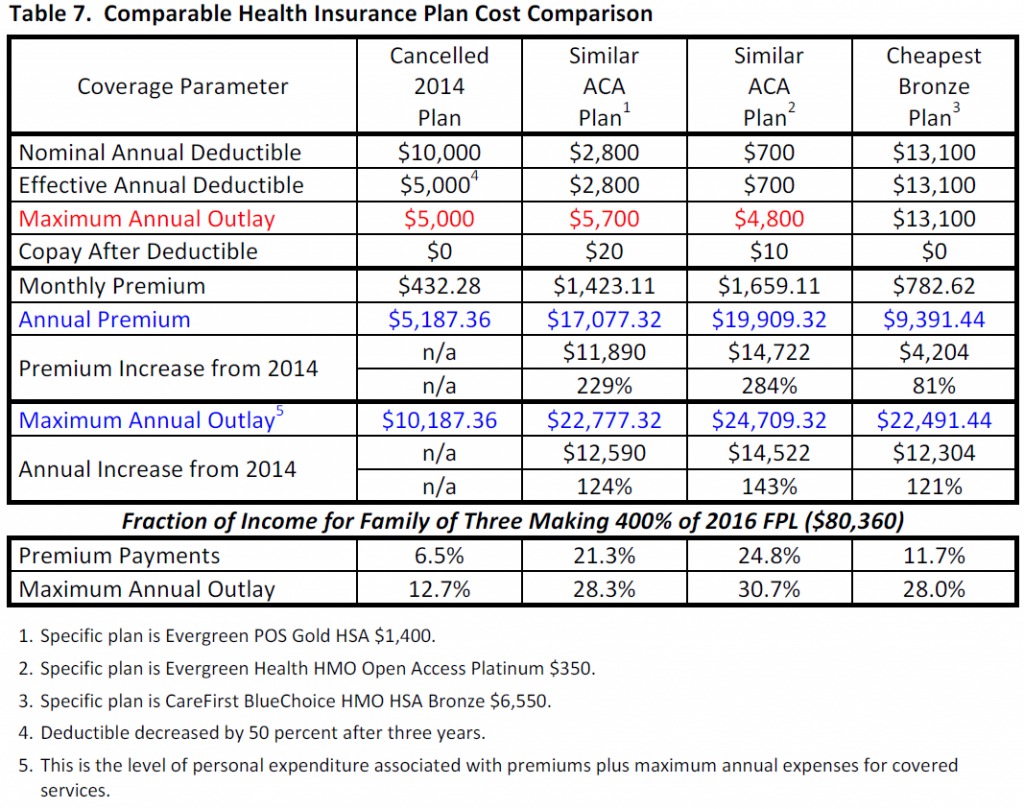
Equivalent Plan Premiums. As described in the preceding discussions, the cheapest 2016 ACA plan option requires an annual expenditure of $9,391 in plan premiums and carries a $13,100 deductible, for an associated maximum annual outlay of $22,491. When compared to my cancelled pre‑ACA health plan, these represent increased premiums of $4,204 (an 81 percent increase), an $8,100 (162 percent) increase in deductible, and a $12,304 (121 percent) increase in the maximum annual outlay. Since the first $22,491 of non‑preventative medical expenses in each and every year must be self‑paid, the ACA plan essentially amounts to a plan under which one pays a minimum of $9,391 per year (i.e., the plan premium) for the right to then pay one’s own medical bills. But wait, surely there’s a better ACA plan, one that provides an equivalent deductible to the cancelled plan. Of course there is. Let’s take a look-see …
Table 7 presents a comparison of the cancelled non‑ACA plan with the only two available plans (on the Maryland Marketplace) that offer comparable coverage under the ACA. The reason that only two such plans exist under the ACA is that maximum out‑of‑pocket costs under the ACA far exceed those of my cancelled plan regardless of metal level. For comparative convenience, I also show the cheapest available ACA plan in Table 7. As indicated, the two comparable ACA plans (that bracket the annual out of pocket maximums for the cancelled non‑ACA plan) have annual premiums that are between three and four times that of the cancelled plan and maximum annual outlays that are more than double. The premiums alone for the ACA plans are nearly double the maximum annual outlay of the cancelled plan. Clearly, for my family to gain, under the ACA, the same level of coverage that we possessed prior to the ACA, we would have to expend a minimum of $12,000 to $15,000 per year in additional annual premiums. The premiums alone for such ACA plans represent 20‑25 percent of annual income for a family of three making 400 percent of the federal poverty level (the level at which subsidies offered under the ACA are completely phased‑out).
Why would anyone purchase such plans? There can be only one reason, but it is first necessary to compare cost data across all ACA metal levels to understand that reason. Table 8 shows the cheapest plans available in the Maryland ACA Marketplace for each metal level. The poor economics of the Bronze level plan relative to my family’s pre‑ACA plan have already been discussed, but if one has to choose (which we all must now do), why not Silver, Gold, or Platinum? Even if one has money to burn, it makes no economic sense for a healthy person to purchase anything but a Bronze level plan. The cheapest Silver plan does have an annual deductible that is $7,600 lower than that of the Bronze plan, but the annual premiums for the Silver plan are nearly $3,500 higher, so that the additional Bronze plan deductible is fully offset in only 2.2 years. Similar calculations yield even shorter paybacks relative to the Gold and Platinum plans. For the Gold plan, $5,600 in annual premium savings fully offset the $10,100 lower deductible in only 1.8 years. For the Platinum plan, $8,900 in annual premium savings fully offset the $13,100 lower deductible in only 1.5 years. Imagine how these paybacks would look if the Bronze plans weren’t subsidizing the Silver, Gold, and Platinum level plans (as they appear to be based on the rate increase analysis presented in my Part 3 discussion).
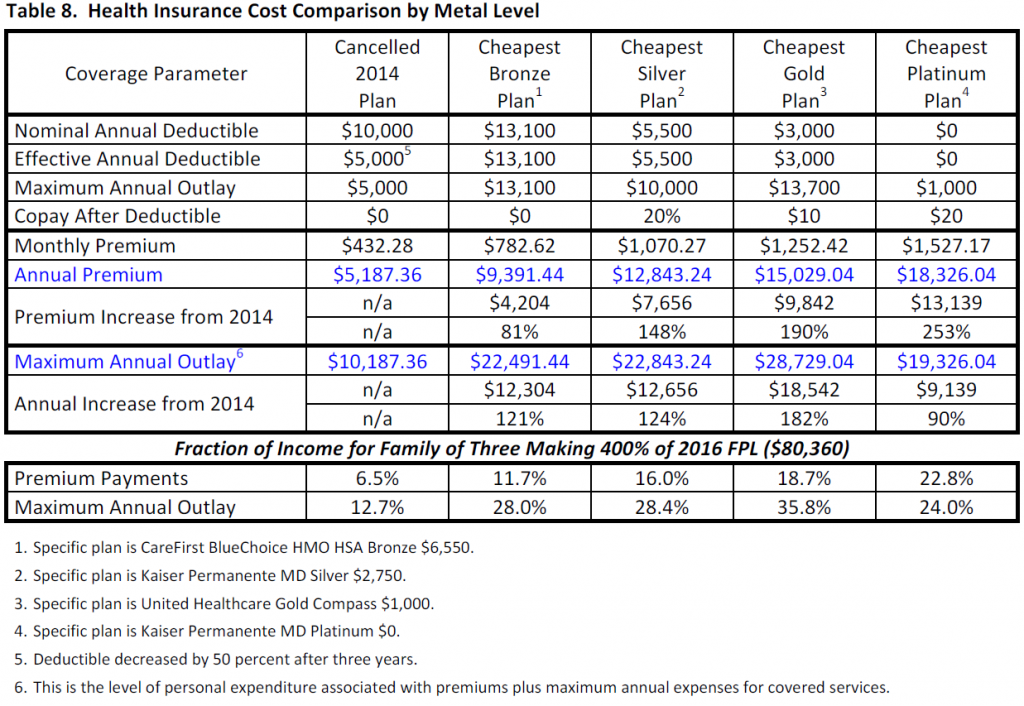
So who buys the higher metal level plans (other than irrational consumers)? Individuals with substantial medical expenses year in and year out. These plans only make economic sense for those who have routine expenses that are greater than the additional premiums plus the associated deductible. Silver plan purchasers will need routine expenses greater than $8,952 per year to economically justify the increased premiums. Interestingly, the payback periods for the Gold and Platinum plans relative to the Silver plan are both almost exactly one year, so approximately the same level of routine expenses makes these plans cost effective as well ($8,638 for the Gold plan and $8,935 for the Platinum plan). In effect, once you reach that level of routine annual expense, all three of the non‑Bronze plans become equally cost effective. At that point, one should actually opt for the Platinum plan since it has the lowest annual maximum expense. Strangely, the Silver plan outperforms the Gold plan due to its lower annual maximum expense. Regardless, the key point is that for annual medical expenses (exclusive of ACA premiums) below $8,600-$8,950, the Bronze plan beats all of the other options going away. For healthy families, the most cost effective option appears to be to buy no insurance at all, deposit the $9,400 in saved annual premiums in a dedicated account, and self‑insure. But of course that is not a long term option under the ACA due to its penalty provisions. It is, however, the option I selected in 2015 under the short term ACA exemption criteria. The ACA effectively turned health care into a gambling venture for my family.
2016, What’s the Answer? Well, who knows? Even though we are now over a third of the way through 2016, my situation for 2016 is still unresolved. The reason? In November of 2015, I applied for a second year of exemption under the cancelled non‑ACA plan criteria. I did this after researching Department of Health and Human Services (DHHS) policy documents that clearly show that the agency has extended the “transitional policy” related to cancelled health plans through September of 2016 (consistent with other allowances implemented to address pre‑ACA plan cancellation). I submitted the application in November assuming the issue would be resolved prior to the close of the 2016 open enrollment period. It was not. I did not hear back from the exemption processing department until January of 2016, when I received notice that the exemption requests for my wife and grandson were denied. I have never received any response for myself. Nevertheless, I appealed the partial decision on January 26, 2016, citing the same DHHS policy guidelines included with my November application. At the end of February, I received a Notice of Informal Resolution indicating that the exemption request was being informally upheld, but that I could request a hearing. I did so on March 3, 2016. To date I have heard nothing regarding the scheduling of such hearing. So, we currently sit in the same position as we did in 2015, uninsured. I may or may not be facing an ACA fine at the end of the year. In the interim, we continue to divert the money we would be spending on ACA plan premiums into a dedicated bank account that we access to provide for our own medical expenses.
At this point, this approach continues to be the most cost effective option for us. Is this a viable long term strategy or one that I would recommend for others? Absolutely not. It’s risky and not a day goes by that I am not strategizing over what to do to resolve this issue once and for all. We are simply responding to the situation that others have created as best we can. The ACA is not a winner for everybody and, as ACA losers, we are playing the cards we have as effectively as possible.
Summary for Now. Does anyone care? I am skeptical. My so‑called representatives either ignore me or send me letters filled with rhetoric (and that is being kind as some of the included statements stretch the limits of veracity). They suggest that I “shop around.” Apparently framing comparisons on the basis of the cheapest available plan does not register with them. If only I accessed the marketplace, surely I would find something more economical. It boggles the mind. When the press issues statements that base rate increase impacts on premiums for 40 year olds, it significantly downplays the substantially greater impacts on older Americans. When the press issues statements that appear to downplay impacts due to the relatively small fraction of individuals affected by the individual insurance market, it demeans each and every participant in that market as somehow less significant than those who obtain insurance through “real” employers. Some examples:
“The rates are not for insurance coverage offered by large employers or companies that are self‑insured, so they would not affect most people.” (www.baltimoresun.com/health/bs-hs-insurance-rates-20150515-story.html) So essentially, no big deal, it’s just those unemployed or self‑employed that are affected. Speaking as one of those “others,” I say thanks for marginalizing those of us who dare to strike out on our own.
“Under the CareFirst rate increase, a 40‑year‑old who lives in the Baltimore area will pay an additional $275 a year on average for the HMO silver plan, which pays 70 percent of medical costs. The rates do not take into account subsidies that defray costs.” [underline added] (www.baltimoresun.com/health/bs-hs-insurance-rate-hike-20150903-story.html) Implying what? That a single 40 year old is typical of all rate payers? The cheapest Bronze plan rates for a family of three with a very young dependent rise by a minimum of $1,000 if that family also switches to a more expensive deductible. The same plan would cost an extra $1,300, and either increase is on top of similarly substantial increases for the previous year as well as the increases associated with ACA plans relative to their pre-ACA counterparts. Finally, not everyone gets subsidies that defray costs. This is always the deflection. A family of three making 400 percent of the poverty level subsidy cutoff is not living high on the hog; such increases are significant.
When representatives of the Maryland Insurance Administration (MIA), the agency charged with overseeing the rights of insurance consumers in Maryland falsely downplay the impacts of their own decisions, I question the sincerity of their efforts. For example:
“Nobody likes to get a price increase, and certainly this is a noticeable increase,” Redmer [MIA Commissioner] said. “But it is a reminder that as consumers, we all have decisions to make. It is an opportunity to go back out and look at the marketplace. We have other carriers selling the exact product as CareFirst at lower rates. So it is a choice that consumers get to make.” (www.baltimoresun.com/health/bs-hs-insurance-rate-hike-20150903-story.html) Well, I’m still quoting the cheapest Maryland ACA Marketplace rates in all of my discussions. I have yet to see an exact (or even lower coverage product) at lower rates than those available under the rate requests that were the subject of this quote. Stop this shopping around misdirection. Consumers are limited to what is available. The plans are what they are. If the MIA has information on a cheaper plan than what I am showing, then I am all ears. Assuming that the MIA is not intentionally misleading consumers, then this only shows that even they do not understand the limitations of the ACA Marketplace. Are they representing the interests of Marylanders in a fully informed manner?
For my own peace of mind and so as not to insult your intelligence, I will refrain from quoting the even more egregious pap included in the letters I have received from my elected and state agency representatives. Let’s at least stop the rhetoric and acknowledge the ACA for what it is. If we want to stand behind it, then do so with an open understanding of its effects. Perhaps then we can really decide what we want and how we can best get there. Maybe some of the information in these discussions will prompt those who claim that ACA improvements are the path forward to actually initiate substantive improvements (in lieu of continuing “patches”). The number of ACA patches that have been implemented, and which do nothing to address the cost burdens or inequities of the existing program, are a prima facie evidence of poor program design. The data are abundantly clear at this point. As currently implemented, the ACA:
-
Establishes a mandated and guaranteed profitable market for a private industry. I would be happy to discuss the options that might be available to require every American to do business with my company. Sarcasm aside, what possible reason is there for retaining an industry when the actuarial basis for its existence has been mandated away. At this point, the health insurance industry is serving an administrative function only and taking (presumably) 15‑20 percent off the top of a program that is adding substantially to the cost burdens of responsible Americans? Given the observed costs, the administrative aspects of this program should be streamlined to the maximum extent practical. If the private insurance industry cannot implement appropriate reforms in return for a perpetual market, then alternative administration mechanisms should be pursued. The fact that “not for profit” insurers continue to spend money on advertising when handed a mandated market with a single point of access says all one needs to know about the cost constraining effectiveness of the ACA.
-
Provides no incentive to stay healthy (or not abuse the system). What differentiates an individual or family that takes their health seriously or doesn’t run to the doctor for every little thing from one that just assumes the system will compensate for (and in the process, enable) their costly behavior? Under a personal responsibility situation, I have no problem with individuals behaving in accordance with whatever vices they choose to embrace and acting on their own idea of what necessitates medical intervention. However, the ACA rewards selfish choices by passing the burden of those choices to others. The ACA replaces a flawed system that cherry picked insureds with an equally (and perversely incentivized) system that makes no distinction between insureds. Intentional or not, this places the primary cost burden of the program squarely on those who don’t take advantage of it, imposing what effectively amounts to a penalty for “being responsible.” For such Americans, this is inequitable and effectively acts as a significant and uncharacterized tax. The ACA likes to sing the praises of shared responsibility, but shared responsible behavior is a primal necessity if we are to subsequently “split the check.” The ACA ignores the former and falsely labels the latter as the sole component of responsibility.
-
Demonstrates no ability to be able to determine whether requested premium rates are fair and equitable. All plan purchasers should be assured that their premiums are being used to support their specific plan and not the plans of others. Subsidizing the costs of any plan by inflating the premiums of another runs counter to the founding principles of the ACA, is a gross perversion of the notion of shared responsibility, and shields insurers from the responsibility of properly pricing individual plans. Oh, you selected a Maserati? No problem, I opted for a Kia, let me pick up some of your tab. It’s only fair.
- Continues to define risk pools based on employment and geography (and who knows what else, except of course, actual risk). Why is the risk pool for a mandated “common risk” program anything other than the entirety of the U.S. citizenry? If we are not going to consider relative health differences, what possible rationale could there be for treating citizen X differently than citizen Y on the basis of employer size or state of residence? Any program that mandates participation and chooses to ignore health differences while maintaining multiple risk pools makes no fundamental sense and will be subject to derision so long as this situation is maintained.
The ACA mandates that families such as mine opt for a health care program that demands (at a minimum) nearly $10,000 in annual premiums for the right to then pay the first $13,000 in non-preventative medical expenses; essentially doubling the cost of pre-ACA health plans. Unless one has serious and ongoing medical expenses, this is tantamount to paying $10,000 annually for the right to self-insure. Unlike the government, families do not have the luxury of operating under a continuing deficit. ACA impacts represent real and substantial burdens that have to be borne at the expense of other spending. Something must be sacrificed. For families living on a balanced budget (yes, some of us do still foolishly pay our bills), this “something” is something previously deemed important. I suspect the revulsion to this program would be far more widespread if every American were required to purchase insurance through the individual marketplace. Let’s unmask the beast, let’s let everybody take a shot at finding an individual market plan next November. Let’s also eliminate the 70-plus percent cost sharing associated with federal health care programs and whatever similar cost sharing is implemented at the state level. After all, such cost sharing is just another tax on those already required to pay 100 percent of the ACA freight via the individual marketplace. Once everyone gets to experience the real pain associated with this program, I suspect there will be a lot less apathy and a lot more attention from those that have the power to do something about the situation. If you are insulated from this program, consider yourself lucky. However, your time may yet come. There are many of us who are already burdened with the dilemma of how to cost effectively live with the ACA, and at least some of us have actually been driven out of the health insurance market by the very program extolling itself as expansionary.
Well, there you have it. At this time, I continue to await further contact on my 2016 ACA exemption hearing. I wish everyone the best of luck, especially those walking in the same shoes that I find myself wearing. Hopefully we can fashion a solution to the dilemma of having to continue to weigh the security of a family against the cost of the ACA.
Less than three weeks after this post, Maryland insurers submitted their individual market rate requests for 2017. Those requests are the subject of Part 5 of this story …
Posted May 10, 2016Questions or comments can be sent to aca@meszler.com