
(Part 3 of ?): Rate Requests for 2016 ACA Plans
(Part 3 of ?): or … Kick ‘Em When They’re Down
Early Summer 2015. As one of the newly uninsured, I roll through first few months of 2015 numb to the precariousness of my position (and that of my family). The ACA exemption I have runs only through 2015, so less than twelve months to come up with an alternative before the open enrollment for 2016 coverage arrives. Unfortunately, my reverie as a health care gambler was interrupted on the morning of May 15 by a headline in the Baltimore Sun (my local newspaper): “CareFirst asks for average rate increase of as much as 30.4 percent” (article is viewable at www.baltimoresun.com/health/bs-hs-insurance-rates-20150515-story.html). CareFirst is the largest health insurance provider in Maryland and the provider of the cheapest 2015 ACA plan referenced in my previous discussions. The article indicated that public comments were part of the rate review process (but of course provided no information as to where or how those comments were to be submitted). So, instead of a summer of uninsured bliss, I set out on a mission to find and review the actual rate increase requests.
Aside #4. My opinion of the conventional news media as uninterested in the actual impacts of the ACA is perhaps best exemplified by a qualifying statement included in the May 15 article, namely that “The proposed rates are for plans individuals buy directly from insurers, through a broker or on a state exchange created under the federal Affordable Care Act. The rates are not for insurance coverage offered by large employers or companies that are self-insured, so they would not affect most people.” Ah, no big deal … doesn’t affect most people. No problem at all unless you happen to be one of the “not most people.” Thanks for the concern. Overly sensitive? Maybe, but where is the follow-up with one of the affected people with regard to what a 30 percent premium increase means? Seems like a logical lead to follow.
Reviewing and Commenting on the Rate Request. With a little digging, I find the rate requests on the Maryland Insurance Administrations (MIA) website. Not as straight forward as it might seem since there are multiple filings for each insurer and these tend to be filed under plan designations that are not easily matched to the plans actually marketed to consumers. Nevertheless, with a little perseverance, the appropriate filings can be isolated. Once found, what one gets to review are four documents titled as follows:
1. Rates & Factors (a pdf file listing the requested plan rates)
2. PART II – Written Description Justifying the Rate Increase (a single pdf page that summarizes the request)
3. PART III – Actuarial Memorandum (a pdf file that “justifies” the request)
4. Unified Rate Review Template (a pdf of a spreadsheet that provides the calculations underlying the request).
To say that these documents are not written for the layman is an understatement. They are tailored solely to industry practitioners. Nevertheless, the information is there if one has the desire to go on a mining expedition. The life of an engineer! If interested, these documents can be found at www.healthrates.mdinsurance.state.md.us/AllRecentDecision.aspx by expanding the “Filing Info” option under the heading CareFirst (BlueChoice), the first such heading with an indicated 27 percent average requested change.
So, I review. Comment? Yup, I want to comment. But when I access the comment instructions, what I find is that comments are accepted electronically and are limited to 4,000 characters (including spaces). Well 4,000 characters isn’t much and, as indicated, the information available is “dense” to say the least. So, it’s not surprising that most of the few comments that are submitted are generalities (and of course there are few comments since most people won’t even be aware of the rate requests unless they see the newspaper article). Nevertheless, I make a go of it … cutting and cutting to get to 4,000 characters. Those interested can find the specific comments at www.healthrates.mdinsurance.state.md.us/Comments.aspx?id=38&mode=RecDec. My comments are about midway through the list (the long comment). So did these comments serve any purpose? I have my suspicions, but who knows since there are no responses in any of the MIA follow‑up documents. In fact, the entirety of the MIA “decision documents” are a two page document describing their modifications to the rate request documents and modified versions of those documents (as described above). Neat, sweet, done.
Aside #5. Through a June 24, 2015 op‑ed in the Baltimore Sun (available at www.baltimoresun.com/news/opinion/oped/bs-ed-carefirst-rates-20150624-story.html), I learned that a hearing had been held on the rate requests on June 17, 2015. This was quite surprising given that there was no reference to such a hearing on the MIA rate request webpage. At a minimum, it would seem appropriate to at least notify online commenters of the hearing. In frustration, I sent an e‑mail to the authors of the op‑ed asking how they learned of this hearing. The (June 26) response I received stated “As regards the hearing – that was held in large part due to request from the Coalition [Maryland Women’s Coalition for Health Care Reform] and 26 other organizations. So, we got heads up and received a [sic] MIA bulletin. However, it is my understanding that MHA [Maryland Hospital Association] only learned about it from us – hence our recommendation that the MIA do a better job of getting this type of information out.” I couldn’t agree more – secret public hearings, quite effective for stemming testimony.
I also commented in my e‑mail to the op‑ed authors on the limitations imposed by the 4,000 character comment restriction. The response I received noted that “As to the challenges of submitting comments – those are being accepted until July 1 and you can send a “normal” document (vs. using their [i.e., the MIA’s comment] tool) to HealthInsuranceRateReview.MIA@maryland.gov.” Useful information to be sure, but it would have been more useful to have been informed of this in a timely manner through the actual MIA website, where the comment instructions included no such information. Putting a complete set of comments together takes time and few of us can simply drop our day to day work to devote the extensive effort required to conduct and document a comprehensive review over a four to five day period. Clients must come first. Nevertheless, such a review (as presented below) can be conducted with reasonable notice, and certainly should have been conducted by the MIA.
I can only conclude that the entire rate request and review process is intended to be handled with as little public “interference” as possible.
The Rate Request Decision. Basically, the MIA scaled the requested rates back a bit, from an average requested increase of 27 percent to an average approved increase of 20 percent (the decision document, which can be viewed on the MIA website, is referenced above). Table 3 shows both the requested and approved rates for the cheapest 2015 ACA plan available on the Maryland Marketplace (the plan described in my previous discussions) as well as the approved rates for the now cheapest 2016 ACA plan and the rates for my cancelled 2014 plan. The cheapest 2015 ACA plan is now the second cheapest plan for 2016 (the cheapest 2015 plan is about 3 percent more expensive in 2016 than the cheapest 2016 plan).
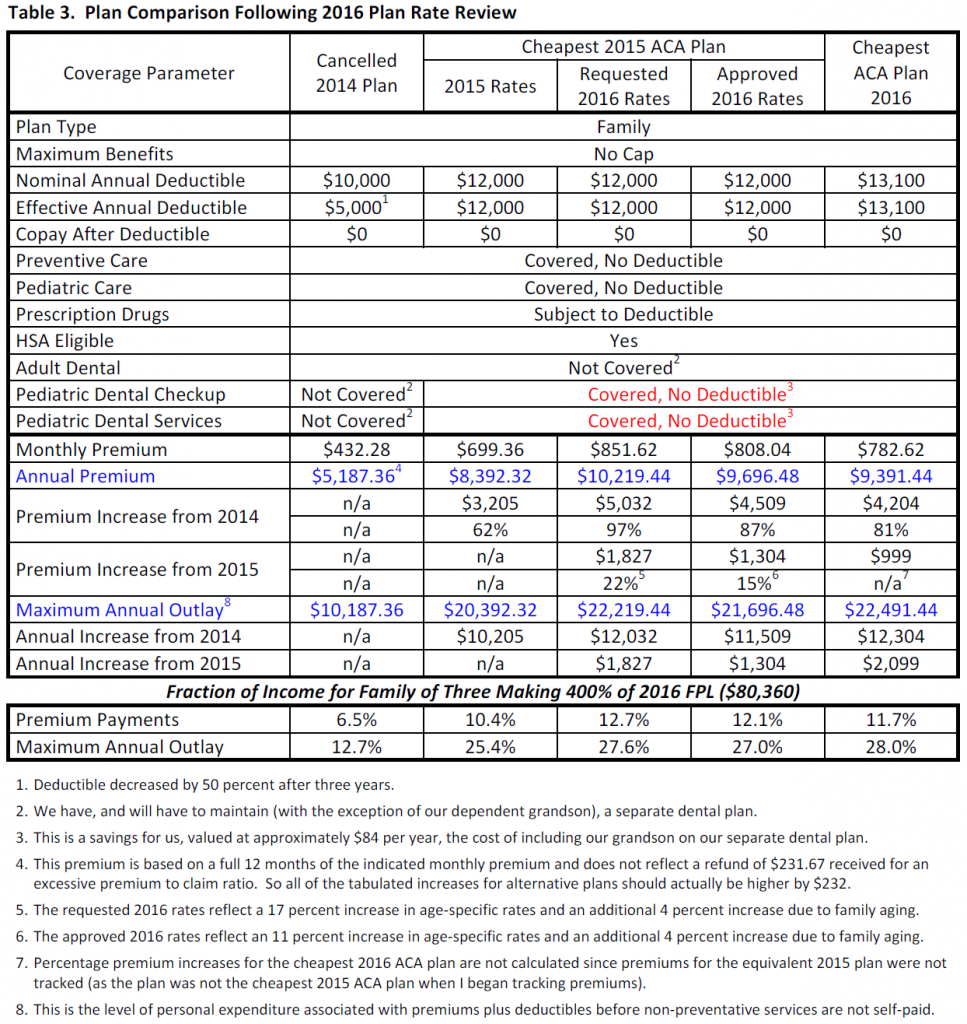
As indicated in Table 3, the 2016 ACA plan rates approved by the MIA are lower than the rates requested by the plan carrier. However, were even these reduced increases justified? Make your own determination, but I’m going to present my investigation here for your consideration. I will, of course, also present my conclusions, but feel free to substitute your own. I welcome anyone to expend the effort required to validate or refute this investigation as my elected and state agency representatives seem to have no such desire. I am but a gnat to them.
My Analysis of the Rate Requests. The information that follows was communicated to each of my elected representatives as well as the MIA via letter dated October 30, 2015. The only response came from the White House and that was in the form of the “get lost” letter referenced in my earlier discussion. Note that my comments are directed at the rate increase request filed by CareFirst as they offered the cheapest ACA plan available on the Maryland Marketplace for 2015 (i.e., the ACA plan referenced in my previous discussions). Note also that insurance offerers do not submit a single rate request document for each affected plan, but a combined document that covers a group of “related” plans. Thus, the review that follows includes all plans offered for 2016 by CareFirst on the individual ACA Marketplace in Maryland.
The Unified Rate Review Template (URRT) provides the data purported to support both the requested and approved (with modifications as outlined in the MIA’s Decision Document) 2016 rates. The specific data cited in this review are from the approved URRT. The experience period (historic) data from the requested and approved URRTs are nearly identical (of course, one would expect them to be exactly identical since they purportedly reflect the past). The forecasted data for the approved URRT shows marginally lower premiums and claims than the requested URRT. I use the more conservative approved data to illustrate my concerns. The illustrations would be similar, but more biased in the direction of my arguments, were they based on the requested data.
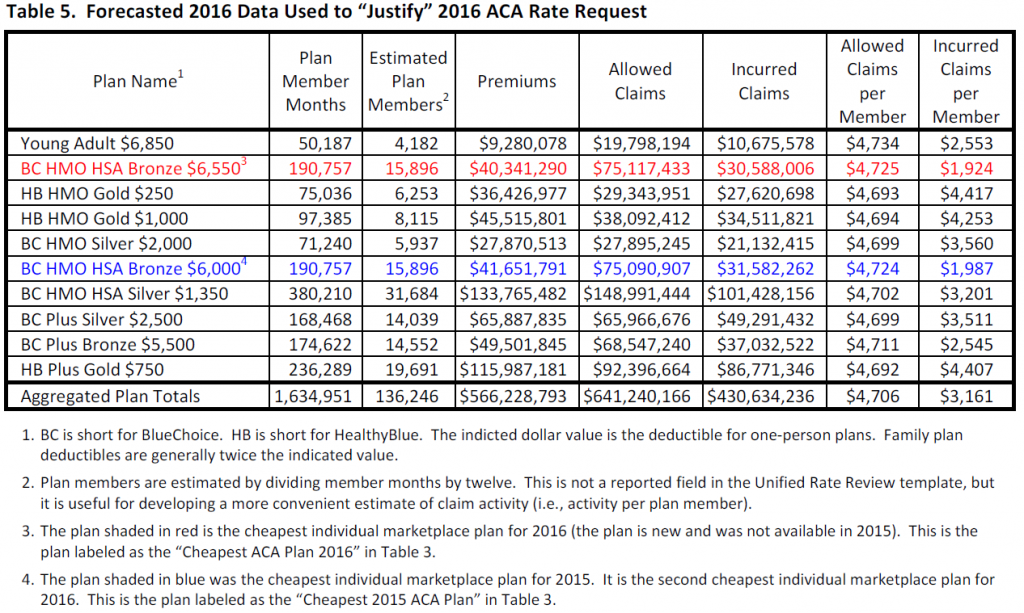
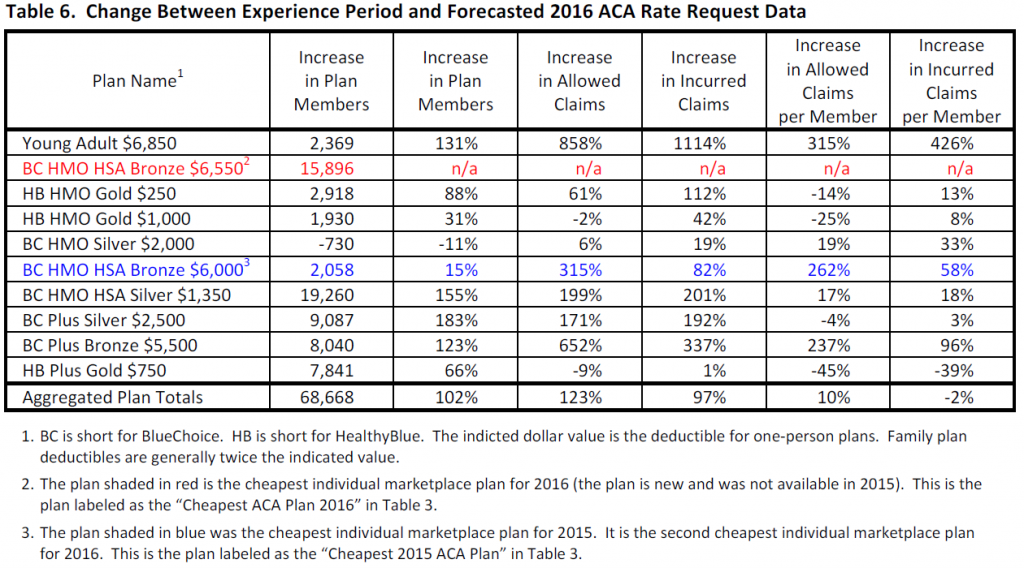
Table 4 summarizes historic (latest year) data from the URRT for the covered plans. These are the “experience” data which presumably support the rate increase. Table 5 summarizes these same data, as forecasted for 2016. These are the membership, premium, and claims data as “expected” when the approved rate increase is implemented. Table 6 presents growth rates for the forecasted data relative to the associated historic data, as calculated from the data presented in Tables 4 and 5. Note that the URRT explicitly includes “member month” data, not plan member estimates. I estimate plan membership by assuming that 12 member months is equivalent to one plan member. I make this calculation simply because per‑member metrics are more intuitive than per‑member month metrics, but it should be realized that the same metrics presented in per‑member terms could similarly be depicted in per‑member month terms (revealing identical growth rates, etc.). Note also that the plan shaded in red is the cheapest ACA plan available on the individual marketplace for 2016 (the plan is new and was not available in 2015) and the plan shaded in blue was the cheapest individual marketplace plan for 2015. The former is the plan labeled as the “Cheapest ACA Plan 2016” in Table 3, while the latter is the plan labeled as the “Cheapest 2015 ACA Plan” in that same table. Thus the shaded entries indicate the performance data used to “justify” the premiums for the specific plans discussed throughout this missive.
The URRT provides data in the form of both “allowed claims” and “incurred claims.” As I understand it, allowed claims are claims that are payable under the applicable health care plan, while incurred claims are the claims actually paid by the plan carrier. The difference between the two (at least as I understand it) is largely one of reinsurance, where another insurer is responsible for a portion of allowed claims. Since I do not know (and it is not apparent from the URRT) how the carrier accounts for the cost (if any) of reinsurance, I have elected to calculate metrics in terms of both allowed and incurred claims to ensure that I am not criticized for mistakenly selecting an incorrect cost basis. The conclusions I reach are fully independent of claim type, but I’d rather be up front and provide data for both claim categories.
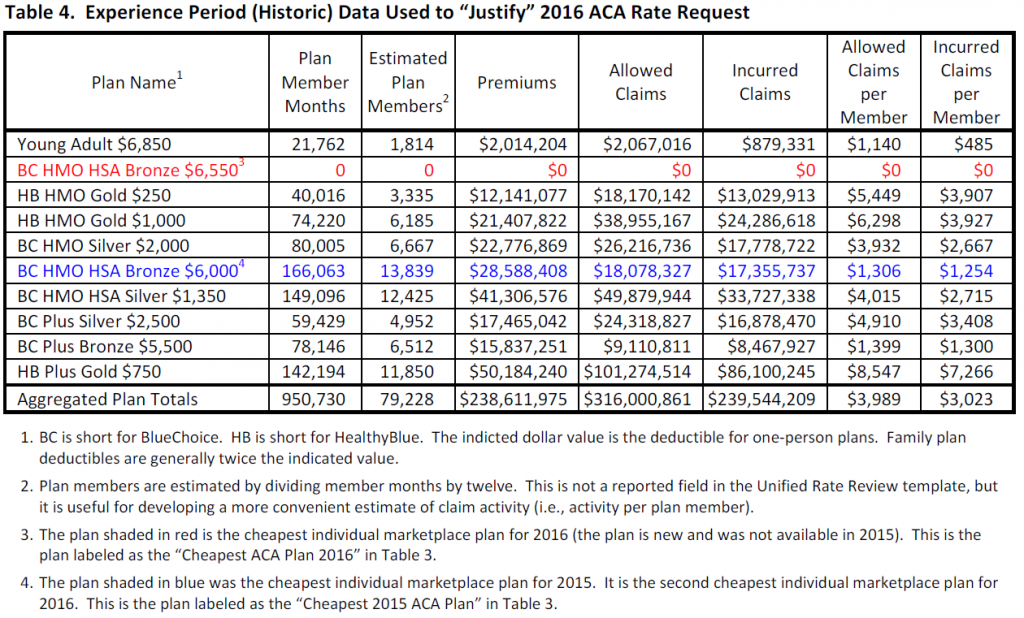
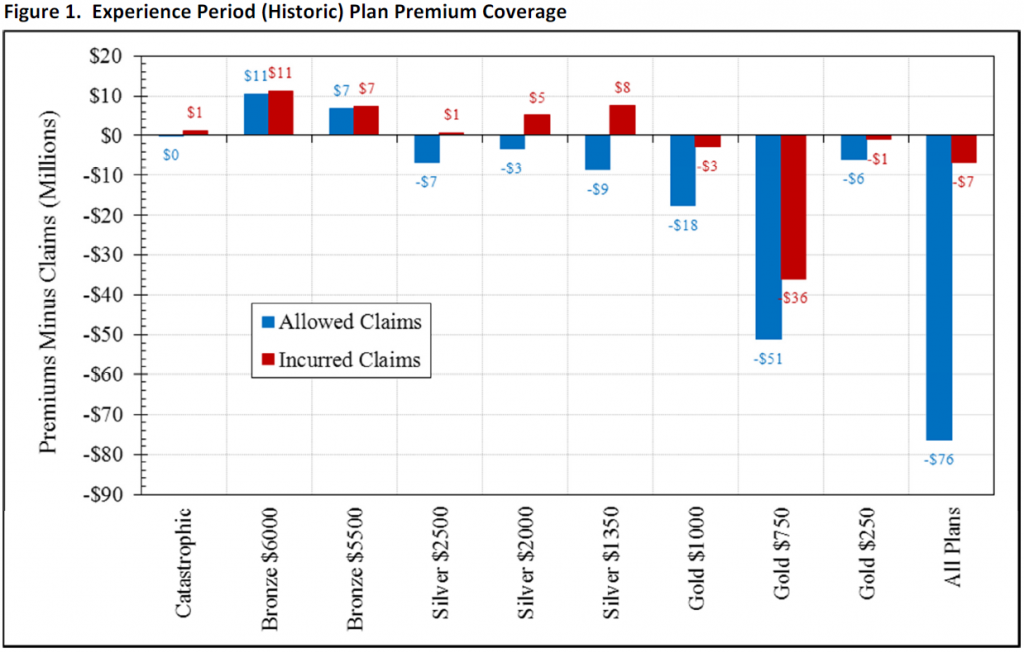
While there is a wealth of information in the presented data, I understand that the numbers may not be provocative in tabular form. I have, therefore, also developed a series of charts that (hopefully) depict why I view this entire rate increase process (both as requested and as approved) as something quite indefensible and, as a result, quite disappointing (but, I guess, not quite so surprising). Figure 1 shows the “excess” premiums collected during the experience (historic) period for each individual plan offered by the carrier. Note that the only experience period plan that is not shown is a catastrophic plan that is not offered in 2016 (the plan is also not included in Tables 4 through 6 for the same reason). The historic statistics for this plan are not outliers. The plan is not shown solely because it offers no insight into the 2016 rate increase process since it has no 2016 counterpart. The Bronze $6,550 forecast period plan (the cheapest 2016 plan) is also not depicted in the charts as it has no 2015 experience period counterpart. The plan labeled as catastrophic in the charts is the “Young Adult $6,850” plan shown in Tables 4 through 6. The Bronze $6,000 plan is the plan presented throughout this discussion as the cheapest 2015 ACA plan.
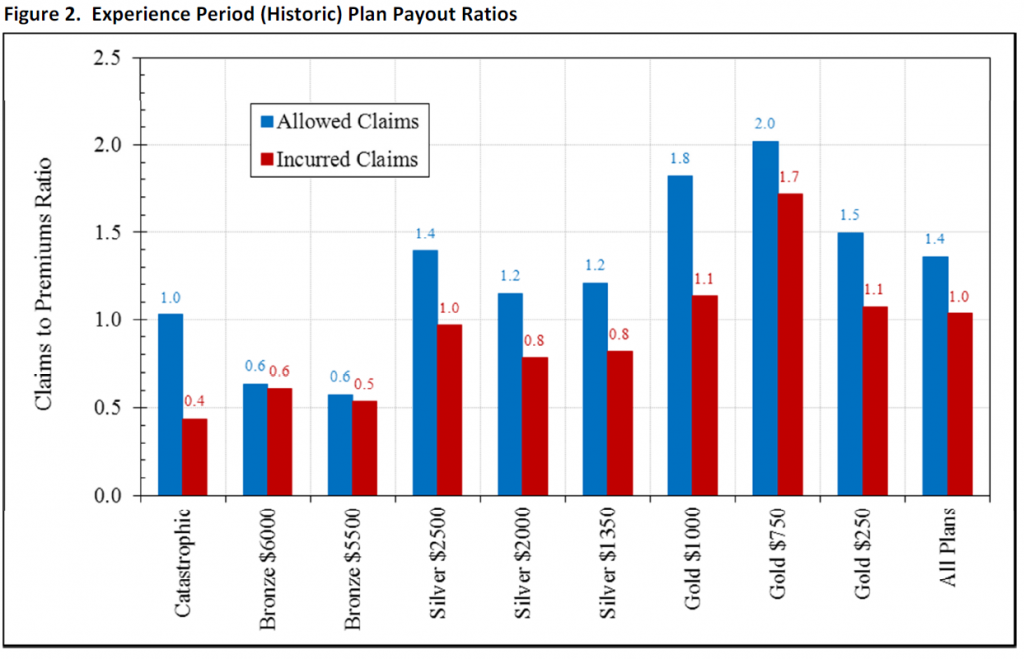
As shown, Bronze level plans generally pay out less than 100 percent of premiums for both allowed and incurred claims. Silver level plans pay out more than 100 percent of premiums for allowed claims but less than 100 percent of premiums for incurred claims. Gold level plans pay out more than100 percent of premiums regardless of claim type. Figure 2 presents these same data in terms of payout ratio, where, as indicated, both Bronze level plans have payout ratios (for historic data) of between 53 and 63 percent regardless of claim type. Thus, the obvious question is, why would such plans require a rate increase? After all, shouldn’t we be raising the rates only on those plans that are underfunded? In fact, the Bronze plan members should be due a fairly sizeable refund as non‑administrative expenditures are far below the ACA’s required 80 percent payout ratio.
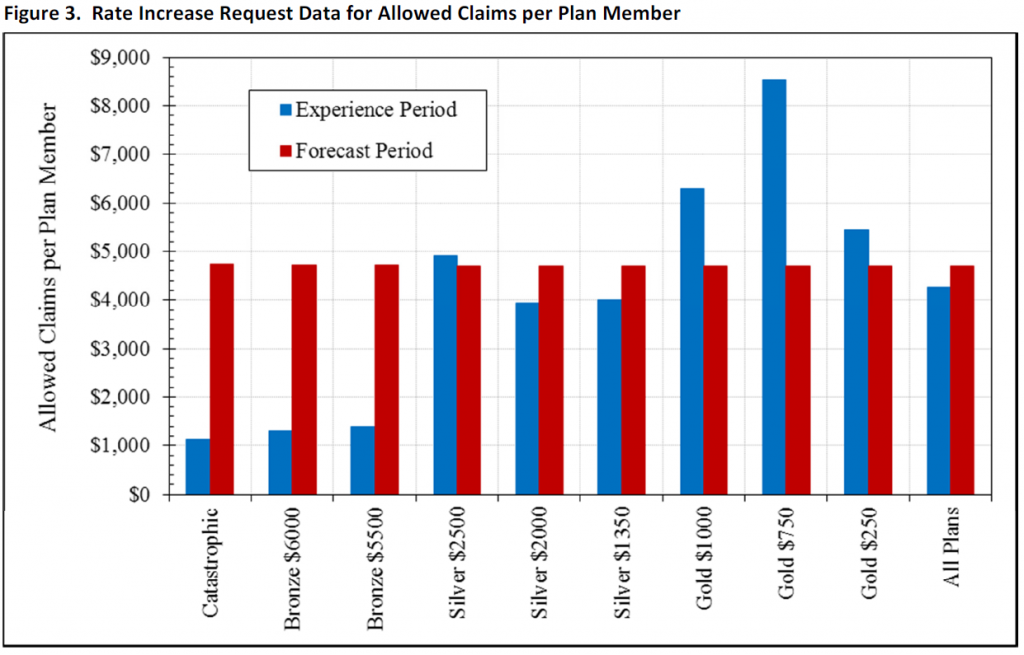
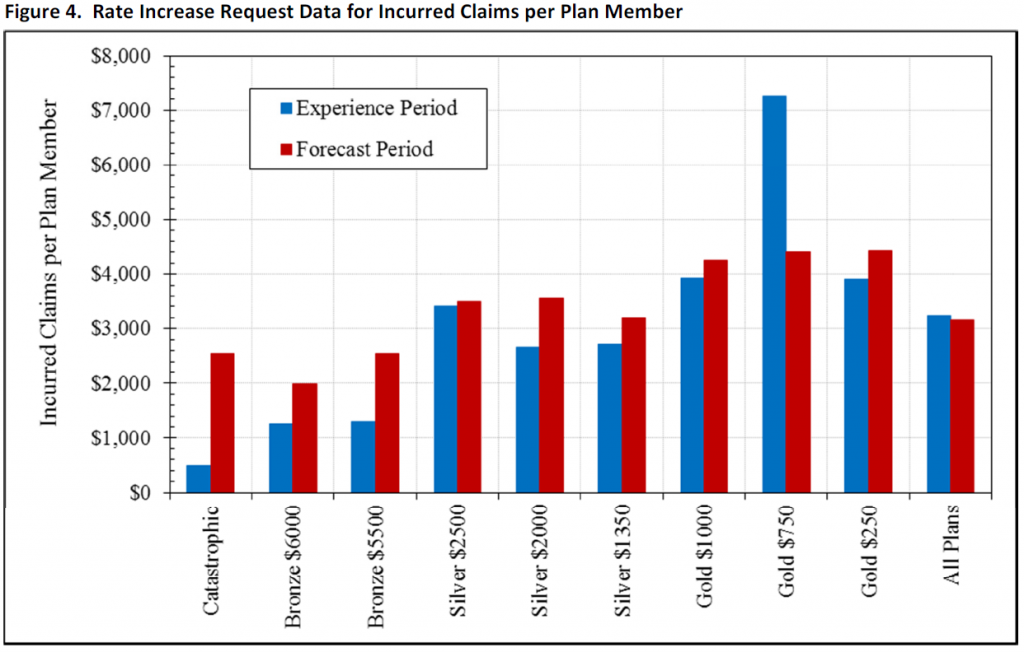
Figures 3, 4, and 5 provide the purported answer. Figure 3 shows the historic and forecasted per‑member claim data in terms of allowed claims, while Figure 4 shows these same data in terms of incurred claims. Figure 5 shows the percentage increases in forecasted plan members and claims per member. Note that (as shown in Figure 3) despite significant differences in experience period (historic) allowed claim activity, the rate increase request forecasts almost identical allowed claim activity across all plans. In other words, a Bronze level plan member subject to deductibles that are many thousands of dollars higher than those of Silver and Gold level plan members is still forecasted to submit the same level of allowed claims. Why, one might ask, would such individuals buy a high deductible plan if they expected significant claims? Figure 4 shows that incurred claims are somewhat more in line with historic activity, but since there is no difference between allowed and incurred claims to the consumer, this does not answer the question as to why so many additional claims are expected in the highest deductible plans. Despite the more in line nature of incurred claims, Bronze level plans, as depicted in Figure 5, still exhibit substantially higher expected growth in both allowable and incurred claims. How is it, for example, that only a 15 percent membership increase in the Bronze $6,000 plan (which just happens to be the cheapest 2015 ACA plan as presented in Table 3 above) could trigger a 262 percent increase in allowed claims and a 58 percent increase in incurred claims?
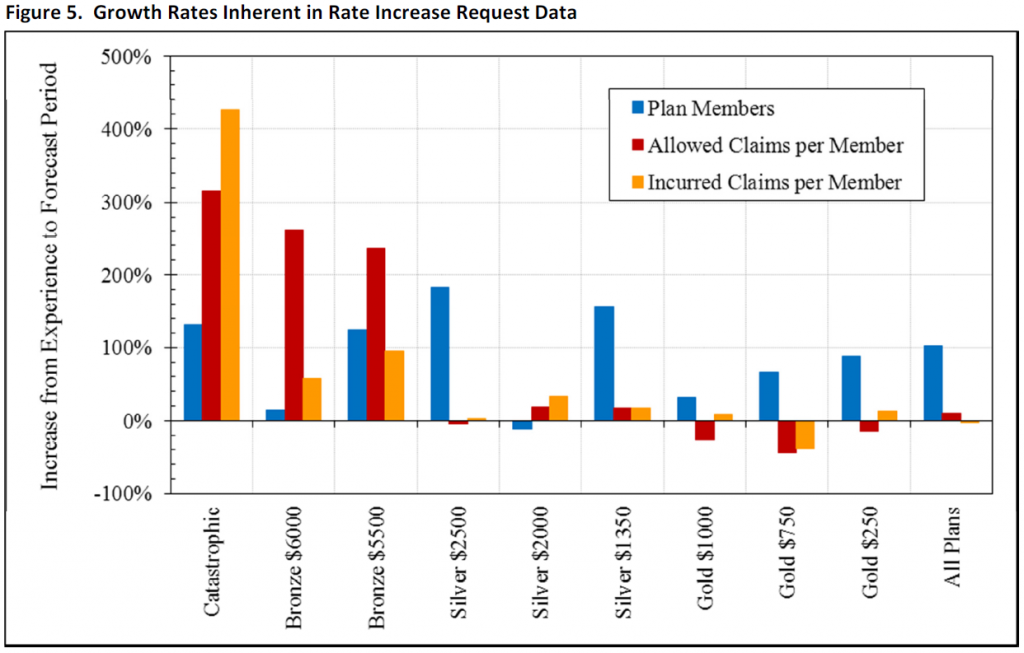
The situation is actually even “stranger” than that. Why would one expect any increase in claim activity for those plan members that were in the plan during the experience (historic) period? Are such members expecting to become more ill now that they have owned the plan for a year? Is there an expected epidemic? If these members are expecting a substantial uptick in new medical treatment, why wouldn’t they switch to a lower deductible plan? The answer is obvious; they are not expecting any such thing. Such individuals have already demonstrated their expected claims activity. That is what the experience (historic) period is designed to measure. The future activity of such individuals is easy to forecast; the data are already known.
So, what happens when we look only at the behavior of the new plan members? If we assume that old plan members continue behaving as they have historically demonstrated, then the difference in historic and forecasted claim activity must be attributed entirely to the differential behavior of new plan members. Keep in mind that assuming that old plan members behave as they did historically does not assume that medical expenses will not rise. Each and every plan has built in age inflation that ensures that premiums increase each and every year regardless of whether a rate increase is requested or approved. As currently designed, consumers will face rate increases of a minimum of 4 percent each year until such time as they can figure out how to stop aging. Age‑based rate increases generally also occurred before the adoption of the ACA, but they were usually implemented in five year age group intervals and were substantially less than 22 percent per interval (4 percent per ACA year compounded over five years). This is yet another Trojan horse of the ACA, but one independent of the main thrust of this discussion.
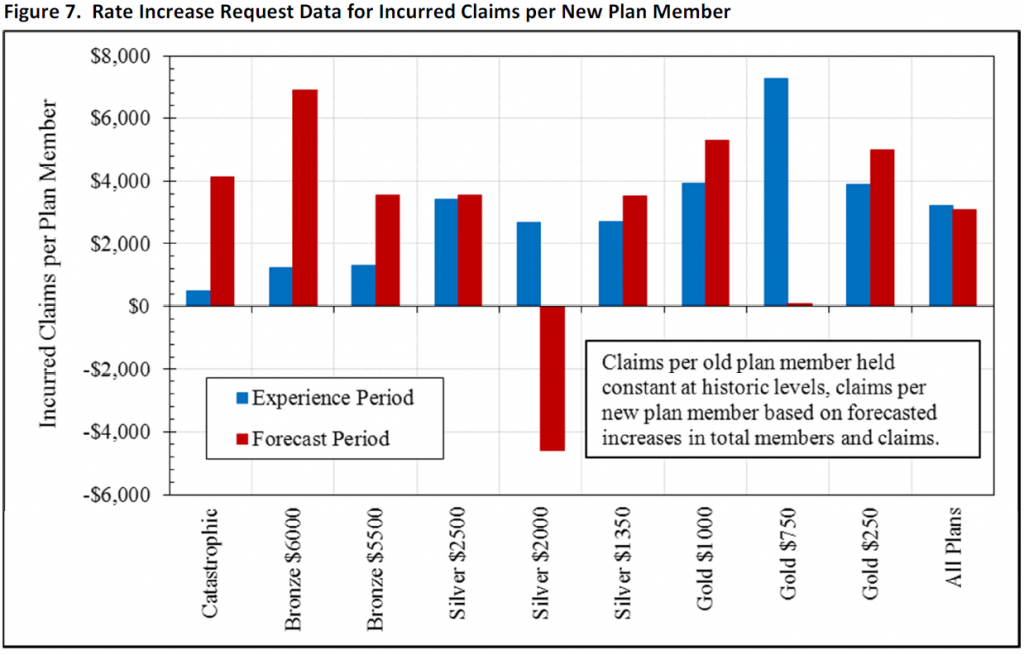
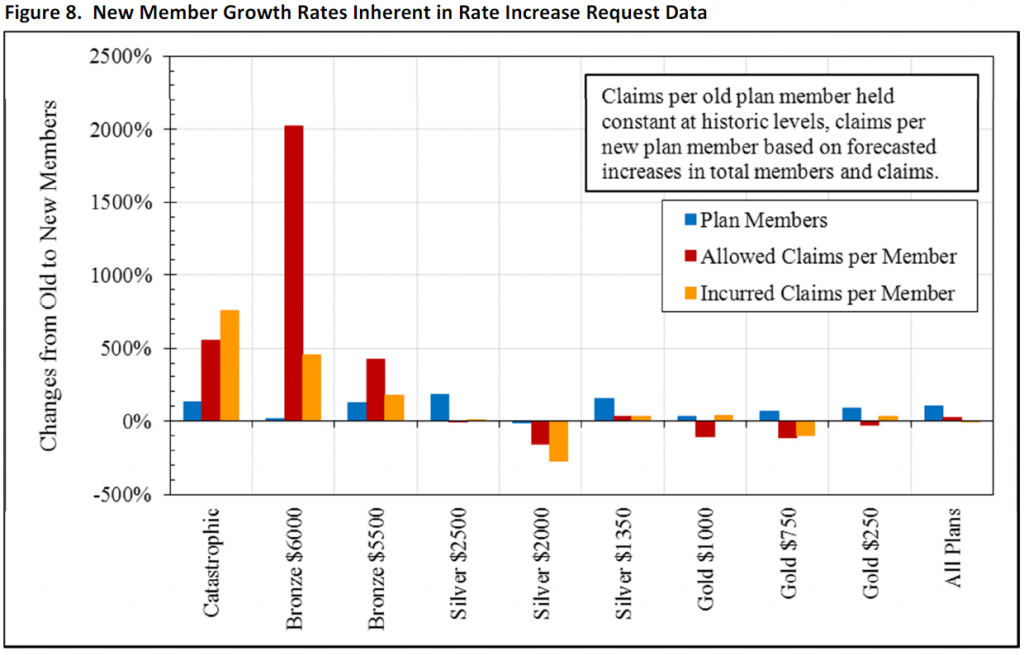
The same URRT data that allows us to calculate the per‑member metrics shown above (that assume that all forecasted claim activity is spread over all forecasted plan members) also allows us to calculate an estimate of the implied differential activity of old and new plan members. Figures 6, 7, and 8 present the resulting activity metrics. These figures respectively correspond to Figures 3, 4, and 5, but differentiate between experience period (old plan member) and forecasted (new plan member) activity. Old plan member activity is synonymous with experience period activity. For Figures 6, 7, and 8, forecast period activity is not total activity as related in the URRT, but the difference between URRT forecasted and experience period (historic) activity, which is synonymous with the behavior of new plan members if the future behavior of old plan members is assumed to be consistent with their historic behavior. The results are illuminating to say the least.
As shown in Figure 6, new Bronze $6,000 plan (which again is the cheapest 2015 ACA plan, as presented in Table 3 above) members are forecasted to submit allowed claims of nearly $28,000, as compared to historic claim activity of just over $1,300. Both are on top of a $6,000 deductible and many thousands of dollars in plan premiums. In short, every new plan member will pay the premiums, pay another $6,000 in deductibles, and then rack up another $28,000 in claims. With incurred claims (as depicted in Figure 7), we see a bit of dampening, but this again is transparent to the consumer (as an allowed and an incurred claim are identical from a consumer standpoint) and reflects internal reinsurance issues and not some change in consumer behavior. Figure 8 shows the same (but substantially more exaggerated) forecasting bias for Bronze level plans that was previously shown in Figure 5.
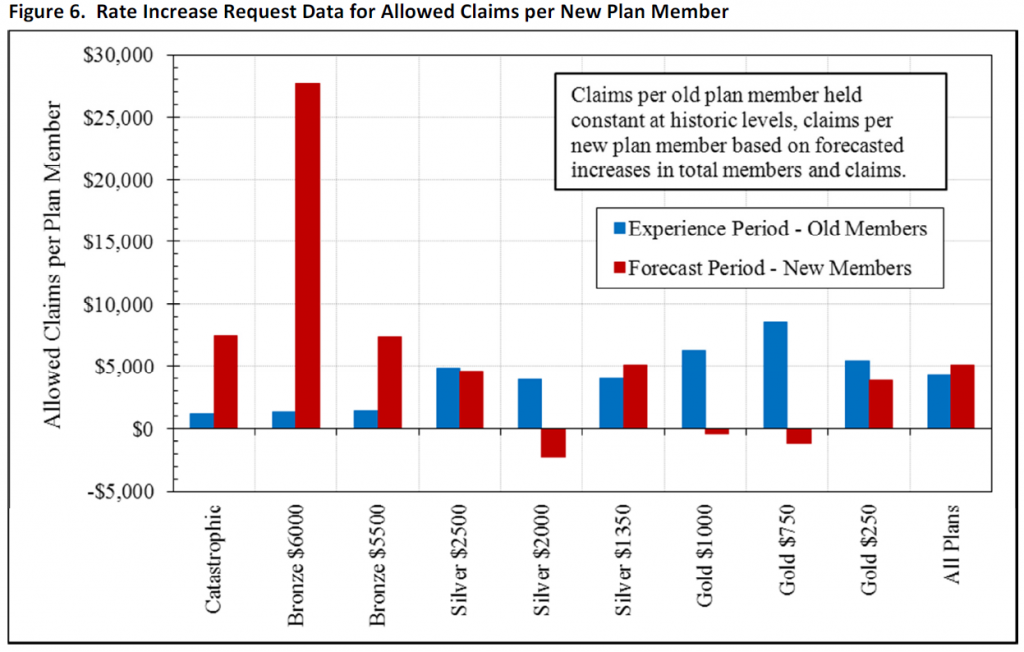
So, what we have is a rate request that is absurdly unrealistic with regard to its forecasted behavior. While it was unrealistic to assume that consumers would exhibit the same claim behavior across all plan levels regardless of deductibles (as shown in Figure 3 above), the forecasting assumptions are shown to be even more unrealistic when the data are “unmasked” to show that new plan members would have to exhibit absurdly more claim activity under the highest deductible plans (as shown in Figure 6). These data would be laughable were they not actually used to support taking money out of the pockets of actual living breathing people, under legislative mandate no less. I can only assume that this is some paper game to spread the cost of low deductible (Silver, Gold, and Platinum) plans across the entire slate of offerings. If we go back to Figures 1 and 2, it is apparent that both Bronze level plans currently have payout ratios that are well below 80 percent. Both should be subject to rate decreases. Silver level plans straddle the zero cost line depending on whether we look at allowed or incurred claims and may, therefore, merit small premium increases to meet an 80 percent payout ratio. Gold level plans are the plans that are clearly not paying for themselves. Significant premium increases may indeed be merited for those plans, but based on the data as submitted in the URRT, I’d want to (were I ever considering such a plan) take a close look at that data before deciding anything definitive.
What should we assume about the impacts of new plan members? Would we expect new plan members to be more or less medically fit than those already insured under the ACA? It certainly seems intuitive that those with significant medical expenses would have been the first to sign up, and that those who are lingering (like me; after having purchased health insurance on the individual market for over a decade) are likely to be those who see no economic benefit to jumping onboard. Are such lingerers likely to jump in and consume 20, 30, or 40 thousand dollars in claims annually, and, if so, would they do this in a high deductible plan? It seems far more likely that most will be forced to bite the bullet, join a high deductible plan, and continue to pay their own medical costs (while also subsidizing the medical costs of others). It is highly unlikely that these consumers will exhibit even the claim activity of those already in an ACA plan. Even if I am wrong and the new members are active claimants, would they not most likely join a low deductible plan to avoid having to incur large out‑of‑pocket expenditures before being able to make their claims? It is virtually impossible to imagine a scenario where claim activity increases fastest in the highest deductible plans.
So, I close on the topic of rate requests by asking … what is the justification for approving rate increases on plans that have overly low payout ratios now? The only rationale I can think of is to soften the blow on the rate increases that would otherwise be required for the low deductible (Silver, Gold, and Platinum) plans. If rate increases are being distributed across plans regardless of individual plan performance, then I now have a clear idea of what the terminology “shared responsibility” really means with regard to the ACA. I am told that there are actuaries that review rate increase requests, and I have to believe that this is true, but what I see in these data does not provide me with any comfort that my best interests are being represented anywhere in this process. I am happy to consider other findings. As I said, the documents reviewed to derive the above statistics are written for insiders. What have I missed? My representatives don’t seem to care since not a one bothered to respond in any meaningful way to a letter describing these findings, but I welcome any alternative analysis that shows where and how I have misinterpreted the rate request data. Quite an interlude in what was to be a reflective year spent trying to fathom a cost effective solution to the ACA. I will continue with my 2016 ACA decision-making in Part 4.
Posted May 8, 2016Questions or comments can be sent to aca@meszler.com