
(Part 5 of ?): Rate Requests for 2017 ACA Plans
(Part 5 of ?): or … Welcome to the Theatre of the Absurd
Early Summer 2016. So, after jamming to put together the history recounted in Parts 1 through 4, I enjoyed three days of uninsured relaxation before reading a May 13 headline in the Baltimore Sun (my local newspaper): “Health insurers seek rate increases in Maryland as United Healthcare quits market” (article is viewable at http://www.baltimoresun.com/health/bs-hs-rate-increases-20160513-story.html). According to the article, “CareFirst has asked the Maryland Insurance Commission for a 12.4 percent increase on its HMO plan and a 16 percent increase for two other plans it offers.” The “HMO plan” is the slate of plans offered to individuals through the Maryland ACA Marketplace (in this case for upcoming calendar year 2017). While the article also cites rate request increases for three other providers as well as discusses the complete abandonment of the Maryland market by one insurer (which, notably for me, was my pre-ACA insurer and thus the provider of the benchmark pre-ACA statistics cited throughout these discussions), I will focus on the rate requests for CareFirst as it is by far the largest health insurance provider in Maryland and the provider of the cheapest ACA plans referenced in my previous discussions.
Apparently, interjecting oneself into the annual health insurance rate request process (a process largely ignorable in the “good old (pre-ACA) days” of annual single or low double digit percentage premium increases) is an added bonus of the ACA. Who could possibly imagine that pre-ACA premium increase levels would now seem a welcome respite! Regardless, what follows is my review of the CareFirst rate request, which I will also be submitting to the Maryland Insurance Administration (MIA) through the public comment portion of their formal rate review public process. Since last year, I have gotten a bit savvier about how the MIA works (most notably with regard to where they “hide” their public hearing notices, which of course is nowhere near the rate request public comment section of their website) and am planning on also presenting my findings at an associated public hearing in July. I will likely accomplish nothing, but it is at least a forum to ensure that that those charged with protecting the public interest are aware of the real world impacts of their decisions.
Aside #6. As discussed in Part 4, I requested (on March 3, 2016) a hearing on my “tentatively denied” ACA exemption request for 2016. It is now approaching four months since that request (and eight months since the exemption application was submitted) and I have heard nothing regarding the scheduling of such hearing. It will be, of course, no surprise should I have to take on additional research related to what is happening with this issue.
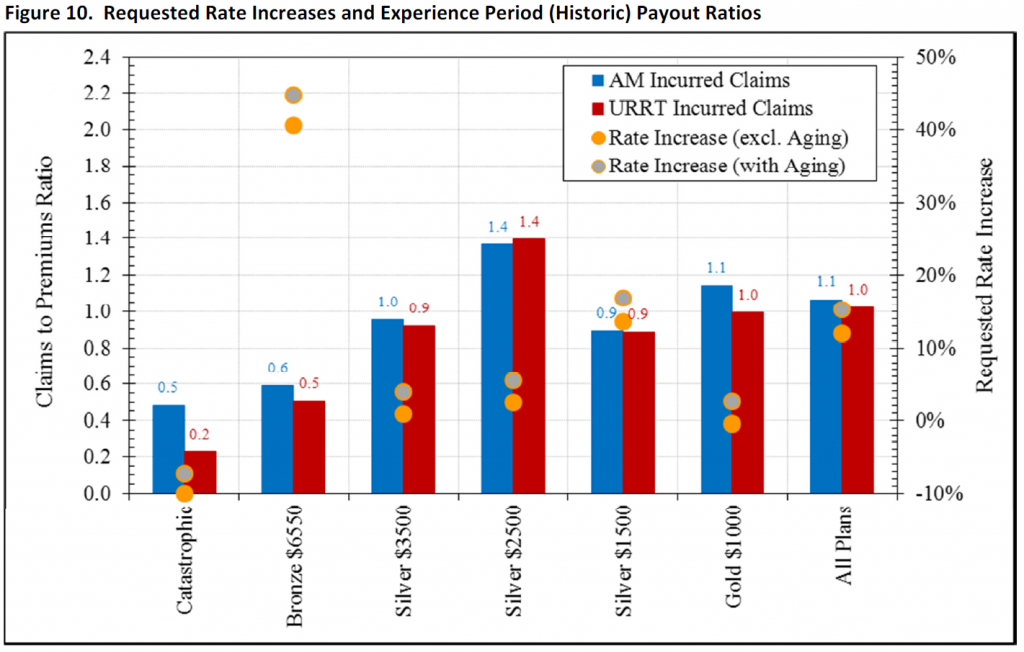
My Analysis of the 2017 Rate Requests. As mentioned above, CareFirst has asked for a 12 percent rate increase for 2017. While one might be tempted to actually call such a request “reasonable” (sarcasm only partially intended) given the magnitude of requested (and granted) increases in previous years, we find (as usual) that the numbers presented to the public tell only a buffered version of reality. What is actually underlying the requested 12 percent average increase strains credibility, especially with regard to what it reveals about the absolutely outrageous design parameters of the ACA. In a nutshell, the average request of 12 percent actually entails a request for individual plan increases ranging from ‑10 percent to +41 percent. Most perversely, the highest requested increase is for one of only two plans that exhibit a payout ratio below 90 percent. In fact, CareFirst’s own data show that the Bronze level plan slated for a 41 percent premium increase exhibits a staggeringly healthy payout ratio of between 50 and 59 percent. Such a plan should be receiving a significant rate cut (as it also should have received during the last rate review cycle when it had a similarly healthy payout ratio of 60 percent).
Note that the statistics that follow rely on the only data available with regard to plan performance, namely that prepared and submitted by CareFirst and made available for public review on the MIA’s rate request website (http://www.healthrates.mdinsurance.state.md.us/AllNewRateReq.aspx, as it existed on June 25, 2016 at the time of this writing). While I would like to believe these data are accurate and can be taken at face value, I am not certain that this is the case as different documents present different (often substantially different) data. To clarify my rational for presenting multiple statistics in the charts that follow, I will briefly comment on both the data made available to the public and some of the associated inconsistencies. Since there is no way for consumers to validate any primary data provided by CareFirst, it is critical that the MIA, as part of their review, ensure appropriate accuracy in CareFirst’s reported information.
The data made available to the public for review consist of four documents: a “Unified Rate Review Template,” a “Part II Written Description,” a “Part III Actuarial Memorandum and Certification,” and “Requested Rate Tables.” The Unified Rate Review Template (URRT) is the only document that provides any real insight into the rate request. It contains significant historic and forecast data that can be used to judge the propriety of CareFirst’s request (as well as to identify inherent defects in underlying ACA rate setting procedures). However, the URRT is highly technical and requires a significant time investment to decipher and even then much of the information requires an “insiders” vantage point to truly understand.
The Part II document includes about one‑half page of text. According to the U.S. Department of Health and Human Services (HHS), “Part II is a consumer‑friendly narrative that provides the justification for the rate increase, describes the relevant Part I data, the assumptions used to develop the rate increase, and an explanation of the most significant factors causing the rate increase” (U.S. Department of Health and Human Services, “2016 Unified Rate Review Instructions, Rate Filing Justification: Parts I, II, and III,” as of February 21, 2015). To the extent that the Part II document consists of prose rather than tables of data, it is indeed consumer friendly. However, the summary‑only nature of the prose and the lack of any explanatory support for the stated figures render the document essentially useless as anything other than an overview of the request. The public can no more provide useful comments with this document than they could without it.
The Part III document includes a little over four pages of summary material related to an underlying actuarial package that is not included. Some of the summary material is informative, but without the underlying data, the utility of that information is severely constrained. This document is also written for the “insider” and is not something the average consumer is likely to understand. In contrast, the Rate Request Tables are, by their nature, quite understandable as they present the requested rates by plan and age, but they provide no insight into the propriety of the tabulated data.
So, in total, consumers interested in reviewing the rate increases are essentially left with a technical URRT document on which to formulate a review. But as soon as one looks at the CareFirst URRT in any detail, “strange” data start to become apparent. For example, the total allowed claims for the CareFirst Bronze level plan are negative (‑$5,621,567), as are the allowed claims that are not the insurers obligation (‑$50,002,931). How does one interpret such data? Are negative claims that are not an obligation an obligation? Do these “negative non obligations” combine with positive incurred claims to produce negative total claims (whatever they are)? Can these data be ignored, especially for a plan slated for a 40 percent rate increase? Are there other inconsistencies that are not so easily identifiable? Without any comparative material on which to base any assessment, I asked the MIA to provide me with the complete Actuarial Memorandum (AM) package that is referenced in the publicly released Part III document. Fortunately, the MIA was able to provide this information in a timely fashion. However, it is not at all clear why it is not included routinely with the public review information made available to all interested parties. There is no question that the AM is technical in nature, but it provides far more information than any document officially released for public review.
With the AM materials, it is possible to crosscheck some of the URRT information (for example, AM page 51 of 53 provides the experience period data that is presumably also reflected in the URRT). Generally, what one finds is that there is quite a bit of discrepancy. Of course, such discrepancy cannot be explained by anyone other than CareFirst. As a result, the consumer, in this case me, is forced to respond by utilizing both sources of information in their review and by interpreting two sets of associated statistics. For this reason, separate AM and URRT statistics are presented in the various charts that follow. Note that two sets of statistics are presented only when both are plausible. For example, the fact that plan specific total allowed claim data from the URRT is not plausible inhibits the use of such data. In such cases, the AM data is presented as the only reliable statistic. Is it reasonable to assume that any of the data produced by CareFirst is accurate if that data cannot be consistently reported throughout their rate request submissions?
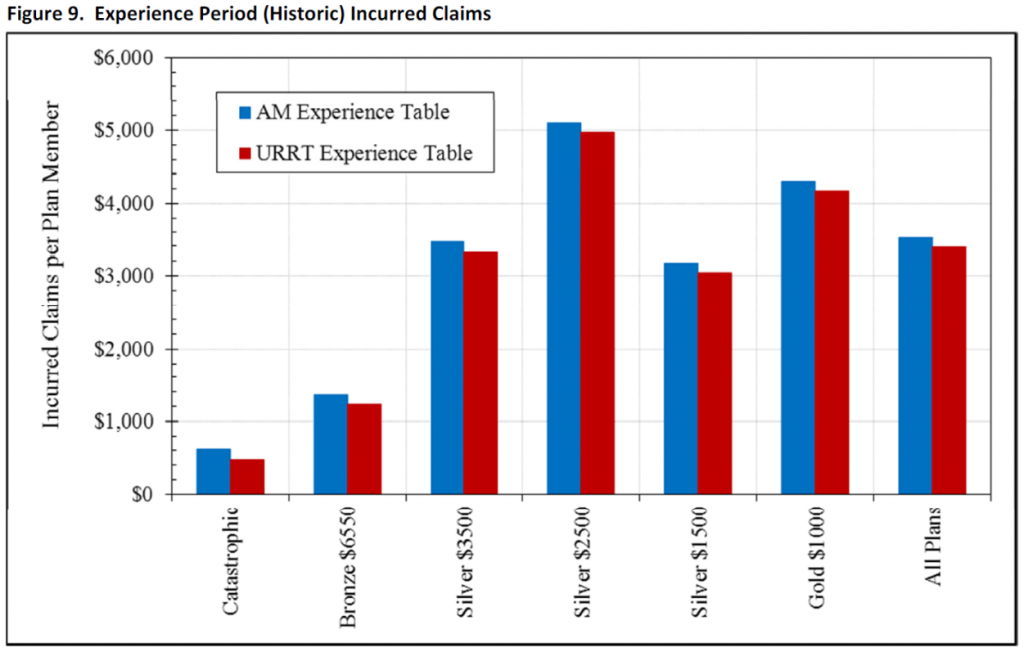
Figures 9 and 10 provide basic statistics for the CareFirst data, revealing key aspects of individual plan performance and relationships between plan performance and requested rate changes. As shown in Figure 9, incurred claims per plan member generally increase as plan deductibles decrease, and this increase far exceeds any difference in plan actuarial value. The Silver $2,500 plan is an apparent outlier, but that may be an artifact of CareFirst including historic premium and claims behavior of members of terminated Gold and Platinum plans in the Silver $2,500 plan (for reasons that are not entirely clear, CareFirst terminates several currently available plans and assigns members of those terminated plans to alternative 2017 plans). One might reasonably expect that increasing premiums would ensure that this effect was limited to the relative differences in plan actuarial values for properly priced plans in a common risk pool, but there are several reasons why this is not observed in the historic data. I will discuss this further in the detailed discussion that follows on the propriety of the requested rate increases.
Figure 10 depicts historic payout ratios and requested rate increases. Of the six plans that CareFirst will offer in 2017, five have associated rate increases of 17 percent or less. However, the Bronze plan, with its historic payout ratio of between 50 and 60 percent, is slated for a 40 percent rate increase (on top of a previously approved increase of 11 percent for 2016 that is not yet reflected in the historic data). Essentially, there is no correlation between the payout ratio of any given plan and its associated requested rate increase. As shown in Figure 11, the requested rate increases, when adjusted for previously approved 2016 rate increases that are not yet reflected in the CareFirst historic data, will bring all but the Silver $2,500 and Gold plans into compliance with an 80 percent payout ratio, while further reducing the Bronze plan payout ratio to an obscenely low 32 to 38 percent. I would note that this same effect was predicted in my comments on last year’s CareFirst rate request, where an 11 percent rate increase was approved for a Bronze plan that then exhibited a 60 percent payout ratio. A full 100 percent of that rate increase went into subsidizing the excessive payout ratios of other CareFirst plans. Bronze plan members garnered not a single benefit from that increase and exactly the same thing will occur should an obscene 40 percent Bronze plan rate increase be approved this year. Note that the aggregate plan payout ratios, at 73‑76 percent, are a little low, but generally consistent with an 80 percent payout target. Problems are not major with regard to overall risk pool performance, but rather isolated to the grossly skewed plan‑specific contributions to aggregate performance. I make this “not major” concession only in a qualified manner, namely with the understanding that I still object to how the ACA has artificially inflated claim activity and thus premiums, but so long as one accepts the fact that this design flaw exists, then CareFirst has come pretty close to estimating the aggregate performance of their plans.
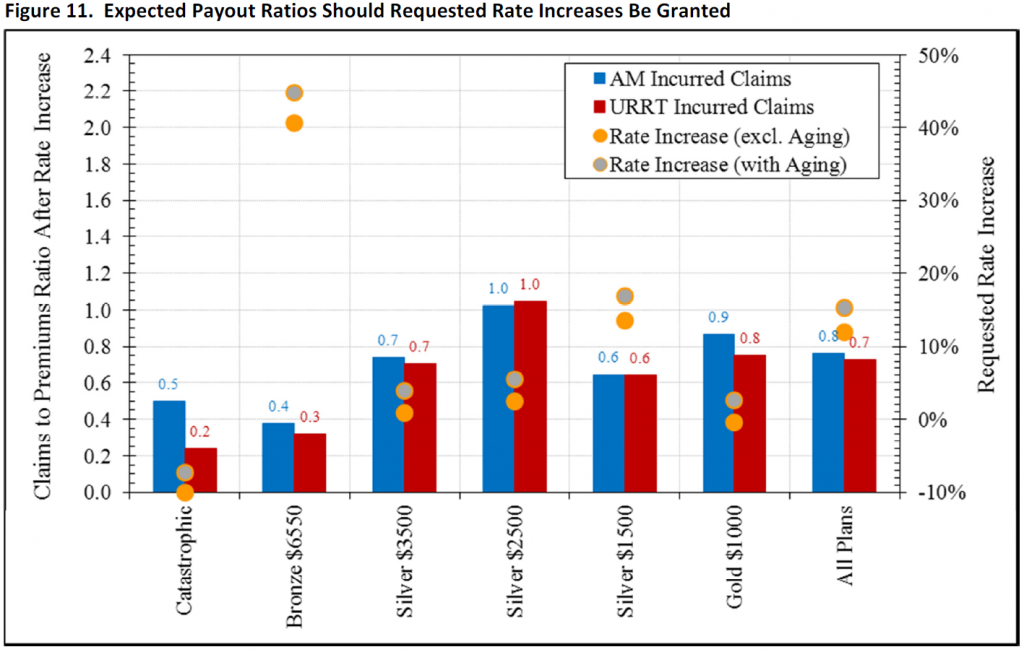
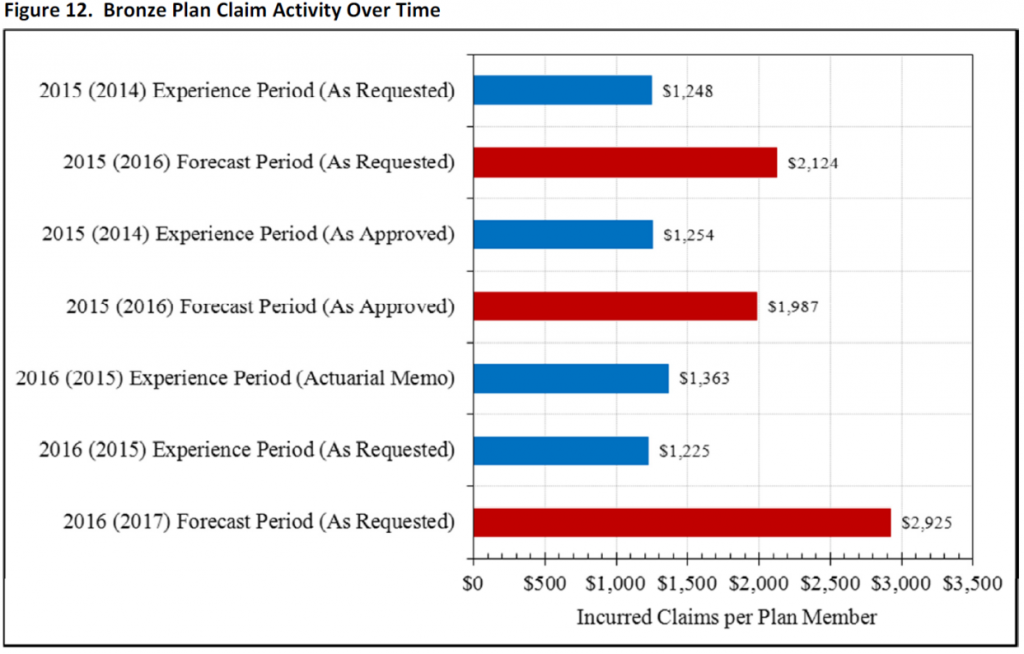
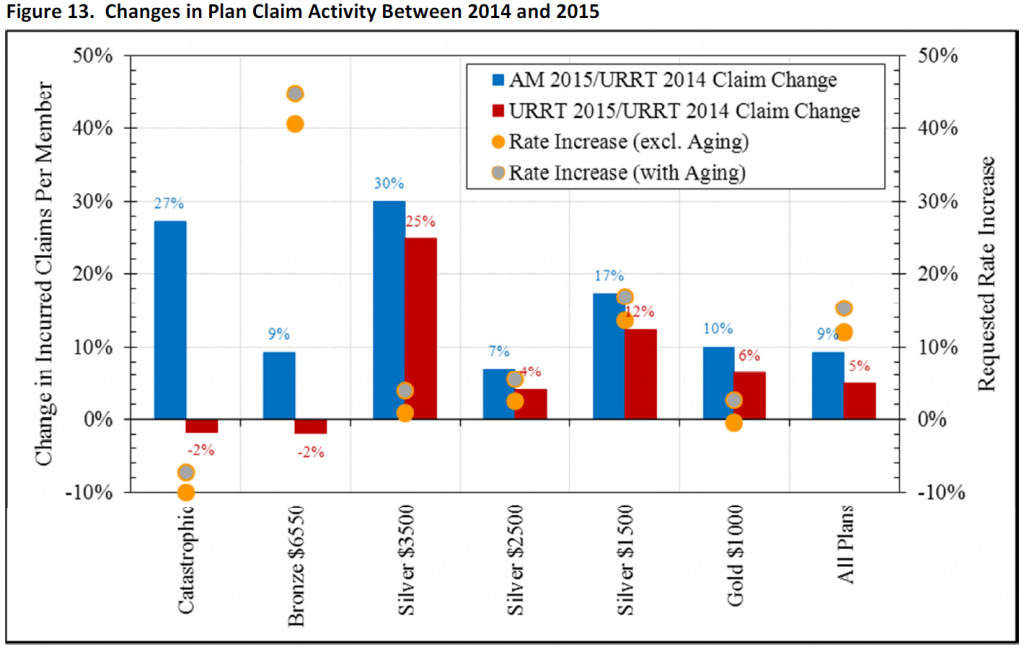
The Figure 11 assessments of what will occur following approval of the requested rate increases assume that per‑member plan behavior will not materially change from that reflected in the historic data. Is this reasonable? I believe that it is quite reasonable for the Bronze plan, but that it may underestimate Silver and Gold level plan claims by 10 percent or so. Figures 12 and 13 depict per‑member claim activity over the last two historic periods for which CareFirst has filed data. As shown in Figure 12, Bronze level plan activity is remarkably flat if one compares URRT to URRT data. AM to URRT data show a somewhat larger change in claim activity, but still quite modest, and certainly well below the CareFirst URRT-forecasted plan‑specific activity levels. Conversely, as shown in Figure 13, larger increases in claim activity have been observed in Silver level plans and the fact that proposed rate increases for most such plans are quite modest could result in little incentive for consumers to control claim activity. However, it is also likely that new members will exhibit lower per‑premium dollar claim activity since those with significant health issues would have been more likely to sign up for coverage during the first years of the ACA. As a result, it seems reasonable to assume that future per‑member claim activity will remain relatively stable given the establishment of appropriate plan‑specific premiums (which will be discussed in detail below).
Using the historic plan performance data, we can also estimate what rate changes should be implemented to produce a full slate of 80 percent payout ratio plans. Figure 14 depicts the resulting rate increases alongside those requested. However, since the historic premium data are for calendar year 2015, the collected premiums do not reflect the plan‑specific rate increases approved for CareFirst for calendar year 2016 (which is the basis for the depicted rate requests). Those increases will already address some or all of the increased premiums required to generate plan‑specific 80 percent payout ratios. Figure 15 corrects for this difference in base years by applying approved plan‑specific 2016 rate increases to the historic (2015) premium data. As shown, the rates approved for 2016 should bring all but one of the CareFirst plans into compliance with an 80 percent payout ratio. Moreover, as was discussed above, the aggregate average 12 percent rate increase request is not dramatically different than what historic trends would dictate (2-7 percent). However, the rate increases requested for individual plans are another story.
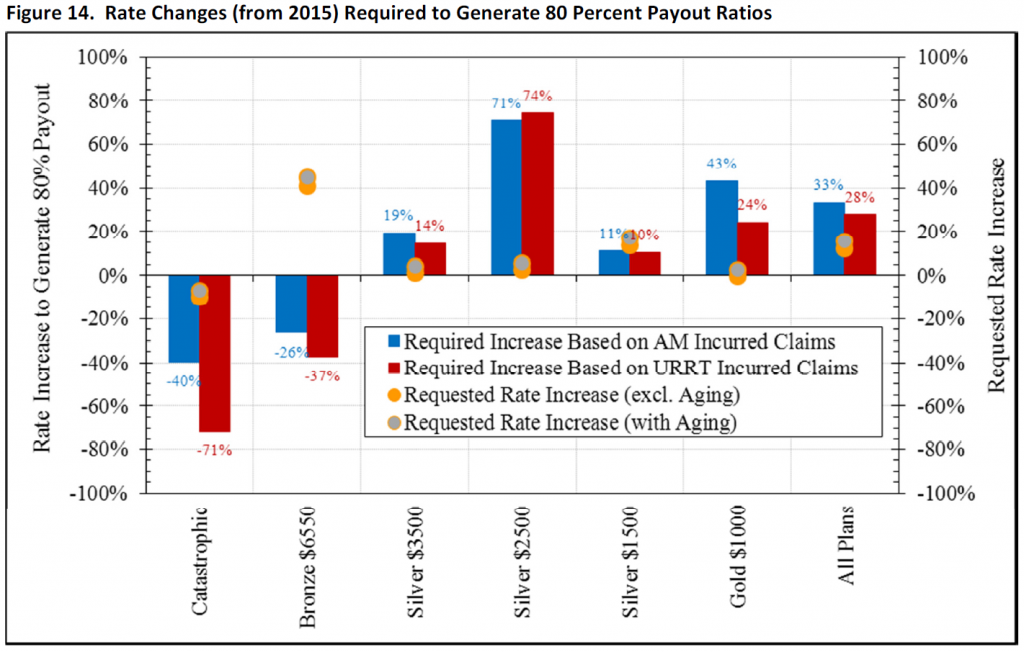
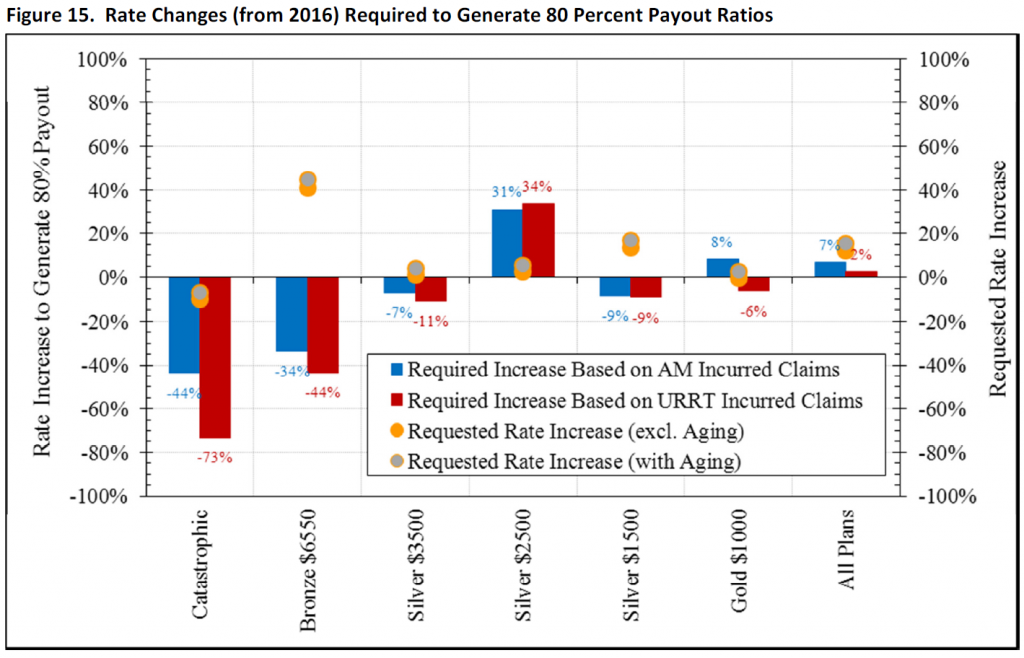
Catastrophic and Bronze plan members should be granted substantial rate decreases from those approved for 2016. Although a rate decrease is proposed by CareFirst for Catastrophic plan members, the magnitude of that proposed decrease is far too low (10 percent versus a reasonable 40-70 percent). Instead of a reasonable 30‑40 percent rate decrease, Bronze plan members are targeted for a 40 percent rate increase. This increase serves only a single purpose and that is to subsidize Silver $2,500 plan members, who merit a 30 percent rate increase, but are targeted for only a marginal two percent increase.
So how does CareFirst arrive at such dramatically different plan‑specific rate requests than a reasoned look at the historic data would dictate? It is difficult to be certain without having direct access to all of their data and analysis assumptions, but the most likely explanation is the use of the fatally flawed methodology employed by HHS to access plan performance and analyze individual plan rates. HHS methodology assumes a single risk pool and that, in and of itself, is not necessarily problematic if program parameters are developed using sound economic analyses and the resulting program parameters are not subsequently manipulated to skew the very behavior upon which the risk pool is based. Let’s assume for the sake of argument that there is no difference between the “medical treatment” behavior of all pool members were they subject to the same symptoms, the same access to treatment, and the same costs. In reality, we know such an assumption is false since the treatment threshold of individuals varies widely, with some requiring little to no formal attention and others requiring attention for the most minor complaint (real or imagined). The ACA includes no consideration of such differences, so that premium money will flow from high threshold consumers to low threshold consumers even when both are subject to the same symptoms and even when the ACA rate setting process is implemented accurately. This is not shared responsibility, but rather shared irresponsibility, but for now let’s ignore this inequity as there is no possible means of addressing it within the context of the CareFirst rate request. Nevertheless, those who profess to be champions of the ACA should be eager to address such inequities if they truly believe in shared responsibility.
Where the ACA rate setting process (as currently defined) goes fundamentally awry is that it fails to address the effects of historic rate setting “errors” and ACA subsidies on treatment levels (and thus incurred claims). ACA premium rates are set on the basis of historic treatment costs for all plans (offered on the individual market) combined and then allocated to individual plans on the basis of plan actuarial value (as defined by HHS). If the premium set for an individual plan is inconsistent from an economic value with the premiums set for competing plans, that plan can carry an “unintended” economic incentive and artificially affect plan-specific treatment rates. Even if the economic value is properly set for all plans, once plan costs are subsequently artificially adjusted via premium credits or other cost sharing measures (as is the case for the ACA), then similar “unintended” economic incentives are introduced into the process. Since each and every “unintended” economic incentive leads to treatment that is fed back into the rate review process for all plans in the aggregate, those incentives result in rate changes that are higher than would be the case in the absence of the incentives, and higher for all plans, not just those that created the incentives. As far as I can tell, the ACA rate review process has no mechanism for even considering such effects (and, in fact, appears to prohibit any consideration of effects not explicitly defined by HHS).
While there is sufficient data available in the rate review process to identify the existence of these “unintended” economic incentives, it is not possible to precisely quantify the magnitude of the effect. That is because the various cost sharing elements of the ACA are treated in the rate review documents exactly as if the full cost had been borne entirely by the consumer. In other words, total tabulated premiums include both direct consumer and subsidy payments. There is no way to know who paid what. What we do know is that for a properly priced plan, premiums should accurately reflect the actuarial value of the plan. So, while some individuals may choose one plan over another for whatever personal rationale they may carry into the process, the economic value (benefits versus out‑of‑pocket costs, including premiums) of the various available plans should, on average for the entire risk pool, be (ideally) constant. You can choose a plan with a more generous actuarial value, but the premiums for that plan should reflect the value of that additional generosity. If this is not the case, one plan will be more economically valuable and plan members will (and should) preferentially select that plan and adjust their treatment behavior accordingly. This action will then affect overall risk pool behavior and lead to higher than expected treatment costs, which feed right back into the rate setting process for all plans.
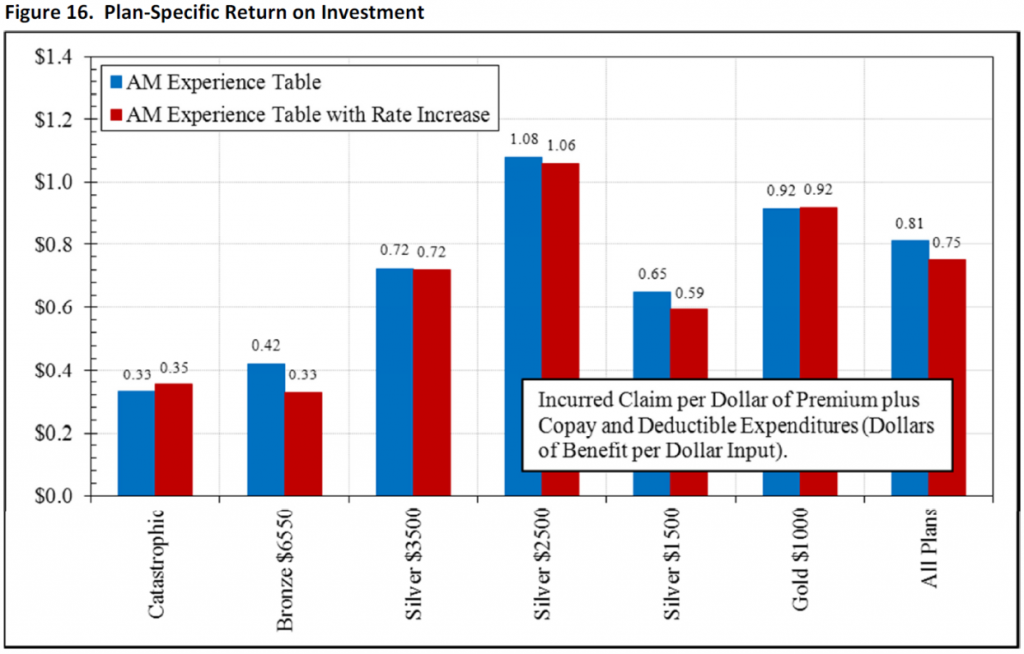
Is this happening? The data presented in Figure 16, showing dollars of incurred claim per dollar of out‑of‑pocket cost paid (premiums plus co‑pays) -– in other words dollars of benefit received per dollar paid into the system –- imply that it is. As shown in Figure 16, Catastrophic and Bronze plan members receive benefits equal to about one‑third of their payments. Silver plan members receive $0.60‑$1.10 in benefits per dollar spent, and Gold plan members receive about $0.90 on the dollar. It is not hard to see who is paying the freight. The design actuarial value of the plans differs by roughly 14 percent between Bronze and Silver (actuarial values of 60 versus 70 percent respectively) and 25 percent between Bronze and Gold (actuarial values of 60 versus 80 percent respectively) level plans. Properly priced plans should roughly reflect this same differential so that consumers are not artificially attracted to or behaviorally influenced by any given plan. Instead, the historic plan data show about a 40 percent value differential between Bronze and Silver level plans (using $0.70 returned per dollar spent for Silver based on the fact that the Silver $2,500 plan is affected by the incorporation of historic Gold level plan members) and a 55 percent value differential between Bronze and Gold level plans. Therefore, although the actuarial values as defined by the ACA may indeed be accurate (since they do not consider the premium cost of a plan), the historic premiums charged for these plans were not. Thus it is virtually certain that actual claims were greater than those that would have accrued in a properly priced system. Of course, higher claims equate directly to higher premiums for all plans.
And the effects of subsidies (both premium and other cost sharing subsidies)? As indicated above, premium subsidy effects cannot be precisely isolated using the rate increase request data since the subsidies are included in the collected premium data. There can be no question however that an individual who pays less than another for the exact same product has an economic incentive to utilize that product more frequently than would otherwise be the case. If I have the same transportation budget as you (analogous to a common health care risk), but pay twice as much for the exact same car (analogous to you getting a premium subsidy), my cost per mile of ownership is much higher than yours and my budget will be expended over much fewer miles. There is no ambiguity … premium subsidies slant the playing field toward higher than average claims. We can see this effect in the rate request data with regard to non‑premium cost sharing (i.e., reduced co‑pays, deductibles, and out‑of‑pocket maximums) as premium and claim data for the Silver level plans that include such features are reported separately in the AM.
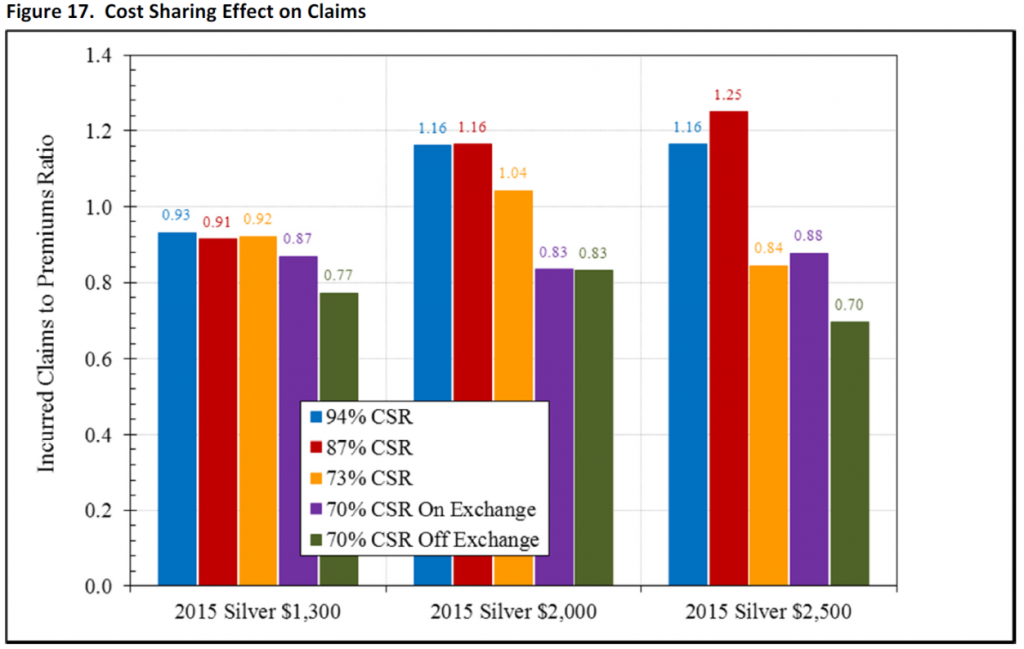
Figure 17 shows the ratio of incurred claims to collected premiums for the various cost sharing levels. In all cases, incurred claim activity for a common risk pool is greater when cost sharing is provided. Comparing the on and off exchange base level (i.e., 70 percent) cost sharing claim activity rates may also provide some insight into the premium subsidy effect since such subsidies should not be available to off exchange plans. Regardless of the premium effect however, it is clear that non‑premium cost sharing incentives slant the playing field toward higher than average claims.
So, is it a big deal? Well, it is if you are one of the individuals being forced to rebalance the playing field. Since “Nine out of 10 people who enrolled in plans in 2015 received subsidies or Medicaid assistance” (http://www.baltimoresun.com/health/bs-hs-insurance-rate-hike-20150903-story.html), “87% of people who selected maketplace [sic] plans for 2015 got financial assistance” (http://obamacarefacts.com/obamacare-subsidies/), and “1 in 6 Americans got a Marketplace plan for $100 or less in 2015” (http://obamacarefacts.com/obamacare-subsidies/) there are apparently not many of us who are actually serving to balance the books. Therefore, to the extent that the ACA professes to function on the basis of a common risk pool and yet arbitrarily adjusts the economic performance parameters that directly affect the behavior of the majority of individuals that comprise that risk pool, those few individuals not directly affected by these adjustments nevertheless incur the indirect effects of the claim activity increases through higher plan premiums. Moreover, since it is now impossible to “put the cork back in the bottle” and undo the cumulative behavioral-influencing effects of the last few years, the only reasonable means of limiting any further damage is to set individual plan rates (rather than combined plan rates) in accordance with an 80 percent payout ratio (or whatever other target is appropriate). Only through such an approach can the effects of the artificial incentives be constrained to those obtaining the benefit of those incentives. Even this constraint is not perfect, but it is a far cry better than pooling the effects of artificial incentives across all plans.
Pretending that historic premiums were set correctly for a common risk pool will only exacerbate the accrued issues. Consumers have already self‑selected their place in the pool by selecting the individual plans that are most advantageous given the distinguishing characteristics of prior poor plan pricing and artificial behavior-influencing subsidies. The effects to date cannot now be undone, and since the ACA includes absolutely no incentives to constrain claim activity beyond the imposed plan premiums, it is time to throw away the façade of independent common risk and set each plan on a sound economic footing individually. Anything less is a slap in the face to those that either do not receive subsidies or who do receive subsidies and yet do not abuse the system. The primary driver of the ACA, at least as I understand it, is equal access to services, not shared irresponsibility. Moreover, if we do indeed accept the premise of a common risk pool, then there should be no effective difference in economic value across plans and each plan should attract members with equivalent “force.” Under such an ideal, setting payout performance on the basis of individual plans or pooled plans should be functionally equivalent. However, only the former provides protections in cases where economic value was not historically equivalent across plans.
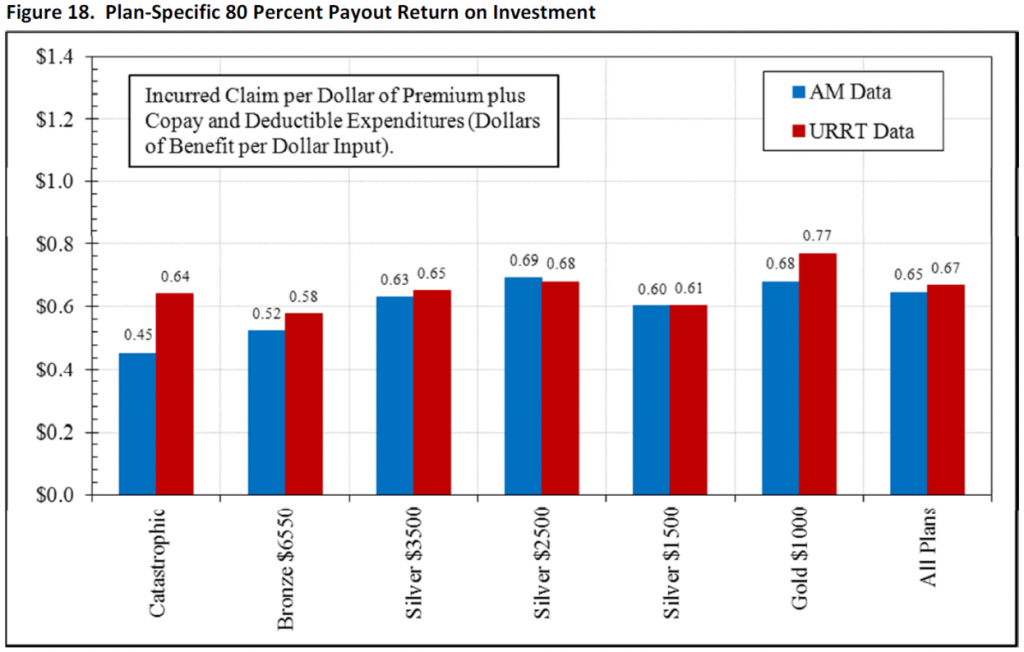
There is plenty of historic data available in the rate request documents with which to set appropriate rate levels to generate an 80 percent payout ratio. Since the unhealthiest individuals had an incentive to join early, new enlistments are unlikely to be less healthy than those already enrolled. Thus, it is highly unlikely that future performance, on a per member basis, will be more expensive than historic performance. Under such an assumption, the appropriate rate changes can be readily established as discussed above and presented previously in Figure 15. Moreover, based on these rate changes, we can also recalculate the per dollar expended benefits by plan as presented in Figure 18. These estimates compare directly with the historic data presented in Figure 16. What is immediately apparent is that the differences in plan specific returns are almost exactly in line with the differing actuarial values of the plans. Bronze plan members receive a 10‑19 percent lower return than the average Silver plan member, and a 24‑25 percent lower return than a Gold plan member. Unfortunately, the rates are still affected (to the high side) by historic design issues, but future additions to the effects already incurred can be curtailed. To accomplish this, it is imperative that rates be established on an independent plan-specific basis, not an interdependent aggregate plan basis.
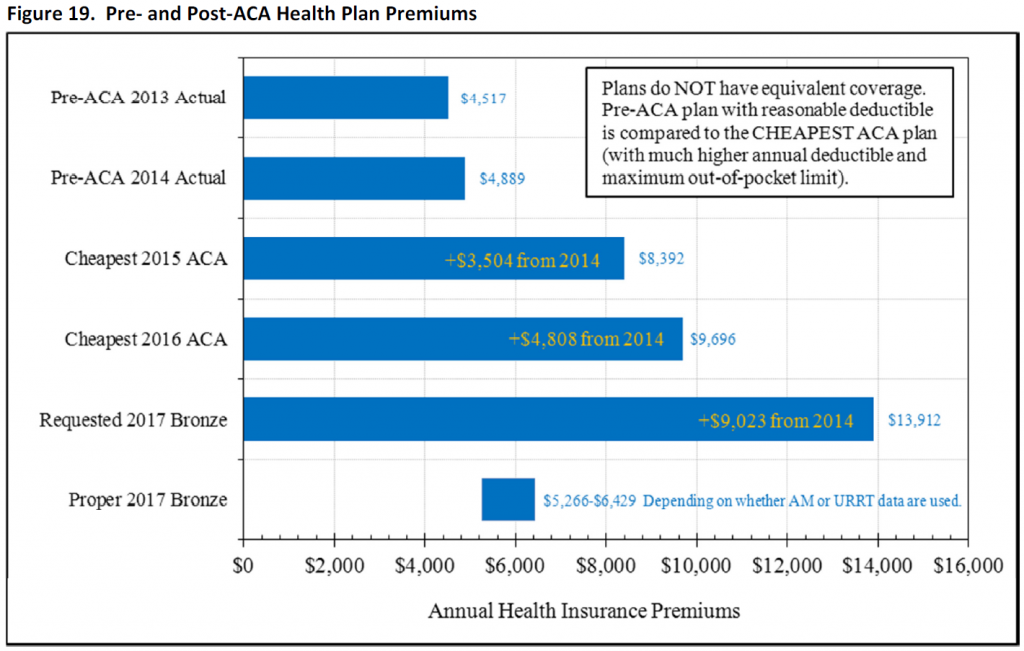
If alternatively, the CareFirst rate requests are approved as requested, Bronze plan members will be faced with absurd rate increases that will return not one dime in additional services. It is unclear if CareFirst will continue to have the cheapest available ACA-compliant individual market plans in Maryland in 2017 (as that will depend on the outcome of their and their competitors rate increase requests), but their requested rate increase would apply directly to the plans cited in my previous discussions as the cheapest ACA-compliant plans in 2015 and 2016. Thus, the effect of the rate increase approval on the premiums for the cheapest plans available for my family through the Maryland ACA Marketplace is presented in Figure 19. It is, of course, possible that this rate increase will finally knock CareFirst out of the position of cheapest provider in 2017, but that determination must await the outcome of the MIA’s rate request decision-making. There can be no doubt, however, that the CareFirst Bronze plan would retain its “cheapest” position if its rate was appropriately set as described above. Under such an entirely appropriate scenario, the potential 2017 premiums for my family would decline from a near tripling of our 2014 premiums to a much more palatable increase of 10-25 percent (depending on whether AM or URRT data are used), reflecting an entirely appropriate decrease of 55-60 percent from the CareFirst requested rate for 2017. Keep in mind that the ACA plans carry much higher deductibles and out-of-pocket maximums so services received per consumer dollar expended (premiums plus out-of-pocket expenses) are lower for the ACA plans (as compared to the pre-ACA plan), even if both carried identical premiums. Specifically, if the requested rate increase were approved, the Bronze plan would carry an annual out‑of‑pocket maximum of $27,000 versus $10,000 under our pre‑ACA plan. Thus the risk of underestimating claims (and premiums) is much lower under the ACA. The 2017 ACA premiums alone would represent 17.3 percent of annual gross income for a family of three making four times the 2016 Federal Poverty Level (the level at which ACA subsidies are not available). The maximum annual out‑of‑pocket expenses for the plan would constitute a full 34 percent of that same income. This is serious stuff.
I have focused here solely on CareFirst as the largest insurer in Maryland and the provider of the cheapest individual market plans to date. That does not mean that the rates for other providers are of any less concern. I simply do not have the time to go through them all. Hopefully that process will be rigorously performed by the MIA during their review of all submitted 2017 rate requests. When the first dollar of insurance coverage comes only after $27,000 in annual expenditures, there is something terribly wrong with the system. The fact that no one seems to care is as troubling as the expenditures themselves.
On July 6, 2016, the MIA held a public hearing on the 2017 individual market rate requests. My statement at the hearing is presented as Part 6 of this saga …
Posted June 26, 2016Questions or comments can be sent to aca@meszler.com