
(Part 7 of ?): Revised Rate Requests for 2017 ACA Plans
(Part 7 of ?): or … Adjectives No Longer Suffice
Mid Summer 2016. How does one even begin to discuss this stuff at this point? What seemed serious less than two years ago, looks mild in comparison to the reality of now. In Parts 5 and 6, I related my concerns with the 2017 individual market health insurance rate request submitted by CareFirst BlueChoice, Inc. (hereafter CareFirst), the largest insurer in Maryland. Reviewing and commenting on those concerns took considerable time and effort (with likely no effect), so imagine my reaction when I learned that CareFirst submitted a revised 2017 rate request less than a month after the request that was the subject on the Part 5 and 6 comments. I characterized the original 2017 request as entering the theatre of the absurd, there are no adjectives that can adequately characterize the revised request, which modifies the average requested 2017 rate increase from 12 to 28 percent, with individual plan increases changing from a previous maximum increase of 41 percent to a revised maximum increase of 63 percent. All of these increases exclude any consideration for consumer aging. Since I am not aware of anyone who is able to halt the passage of time, the effective average requested rate change for a living breathing human being is being revised from 15 to 32 percent, with individual plan increases changing from a maximum of 45 percent to a new maximum of 68 percent. These are all one year changes that come on top of multiple previous annual double digit rate increases.
Why the Revision? The overwhelming factor leading to the revised rate request is a change in the applied morbidity factor (which essentially represents the rate at which plan holders submit claims versus historic claim data) from 1.0 in the original 2017 rate request to 1.168 in the revised 2017 rate request. CareFirst justifies this change by stating (on page 55 of 58 of their revised Actuarial Memorandum) that:
“Emerging 2016 allowed claims cost along with DxCG burden risk scores indicate that 2015 members have significantly higher morbidity in 2016. A factor of 1.07 has been applied to the morbidity calculation to reflect this change. In addition, the morbidity assumption for new members, which assumed a healthier population in our initial filing, has changed to reflect emerging 2016 experience that indicates that members who are new to CFI in 2016 have significantly higher claims costs than the existing population. A factor of 1.15 against the existing members has been used to develop the new member morbidity.
The projected morbidity with these changes is now at 1.168.
Note that our platinum plans were uniformly modified into gold plans on 1/1/16, which has significantly raised the expected morbidity for all remaining metal levels, particularly gold (80% remained in gold, 15% switched to silver, 5% to bronze).”
Note that this statement is not supported with one shred of evidence. If emerging data on allowed 2016 claims does indeed support this assertion, then that data should be presented for all to review. Moreover, do incurred claims also reflect this purported trend? It is the latter that affect CareFirst’s bottom line. Additionally, if this purported trend is true, is it plan specific? Has the trend been adjusted for age? Since all 2015 members would be one year older in 2016 and CareFirst’s approved rates include an automatic age based increase of nearly 5 percent, has this 5 percent been factored out of the 7 percent morbidity estimate? In other words, is there a net 2 percent morbidity increase, or a gross increase of 12 percent? And finally, what is causing this purported trend? Why would existing plan holders suddenly increase their spending by a net of 7 percent? Is the increase isolated to large cost sharing plan holders, or is it across the board? Why would consumers already strapped with insanely (yes, insanely) high premium and deductibles suddenly decide to self-inflict even greater pain by pushing their economic burden even higher? If the effect is true and due to the runaway impacts of the lack of any cost containment for low premium, low deductible plan holders or for a medical community that is only too willing to support such runaway behavior (for obvious profit reasons), why should such effects be passed to all consumers? How does this stop? Of course, without any data, all of these are simply questions without answers, but they are indicative of the types of questions that should be asked and answered before any rate requests associated with changing morbidity assumptions should be approved.
My Further Comments. I presented substantial data in my Part 5 (and Part 6) comments showing that the subsidy effects of the Affordable Care Act can (and do) affect consumer behavior and it would be absurd (as stated in those comments) to pass the cost of these behavioral inducing effects to non-subsidy consumers. I would explicitly note here that my Part 5 and Part 6 comments (in their entirety) are equally valid with regard to the revised rate request. I withdraw not a single aspect of those comments. While particular tables and charts associated with those comments do not fully reflect the latest rate request data, the experience period (i.e., historical) data of the original and revised rate requests are identical, as are the surrounding issues, comments, and conclusions. While I will present a few modified charts below to illustrate the updated net effects of the revised request, I am not going to reproduce the Part 5 or Part 6 comments in whole, and instead incorporate them by reference.
Also, before delving into the morbidity data specifically, let me state that there continue to be significant discrepancies between data reported in CareFirst’s URRT (Unified Rate Review Template) and CareFirst’s Actuarial Memorandum. Moreover, although discrepancies were also noted between these same two documents in the original rate request comments, the discrepancies in the revised filing are not consistent with those of the original. For example, the overall 2015 payout ratio according to the Actuarial Memorandum (both original and revised) is 106.5 percent. The refiled URRT shows that same ratio to be 89 percent, while the original URRT shows 102.2 percent. While I am all for scrapping the URRT in its entirety as it reports (or rather should report) redundant historic data and nonsensical (by design) forecast data, the two documents should at least be consistent if both are going to be filed. If it is not possible to accurately report data across the rate request forms, how can any reviewer assume which, if any, of the reported data are reliable? If CareFirst purports their URRT data to be reliable, then I recommend starting with an assumed 89 percent historic payout ratio for determining 2017 allowable rates. In fact, the historic data reported in the revised URRT is so different than that of the original URRT and both the original and revised Actuarial Memoranda that it is not usable even for comparative purposes and I have, accordingly (and unlike the Part 5 comments), omitted all URRT comparisons from the charts that follow.
With regard to morbidity, the statement quoted above and a single table presented in the revised Actuarial Memorandum (on page 10 of 58) appear to comprise the entire CareFirst justification for further increasing their 2017 rate request. The table does indeed show a net change in assumed morbidity of 16.8 percent, consistent with the morbidity change statement. But that is the only thing that is consistent in the table. It is almost as if the rest of the table is just for show. Let’s assume that the presented 2015 (i.e., historic) data are correct. The member data are generally (albeit not exactly) consistent with the 2015 member data reported elsewhere in the Actuarial Memorandum. The claim data also appear reasonably consistent but cannot be verified due to “normalization factors” that are inherent in the tabulated data, but are not themselves presented. The 2015 net claim factor of $378 per member is not correct for the given plan specific data. The correct net claim behavior for the stated plan specific behavior and membership data is $391, or $389 if one uses the more detailed 2015 member month data reported elsewhere in the Actuarial Memorandum. This factor is quite important to the overall morbidity calculation as it reflects the starting point against which the estimated 2017 behavior is compared (a lower starting point yields a greater morbidity increase factor for a given 2017 claim estimate). I would note that the presented net claim factor of $378 is very close to the net unnormalized claim factor of $380 associated with presented 2015 unnormalized claim and member month data, but the bottom line is that like so much of CareFirst’s data, it is impossible to replicate with the information they provide. Table 9 presents a summary of these various baseline data.
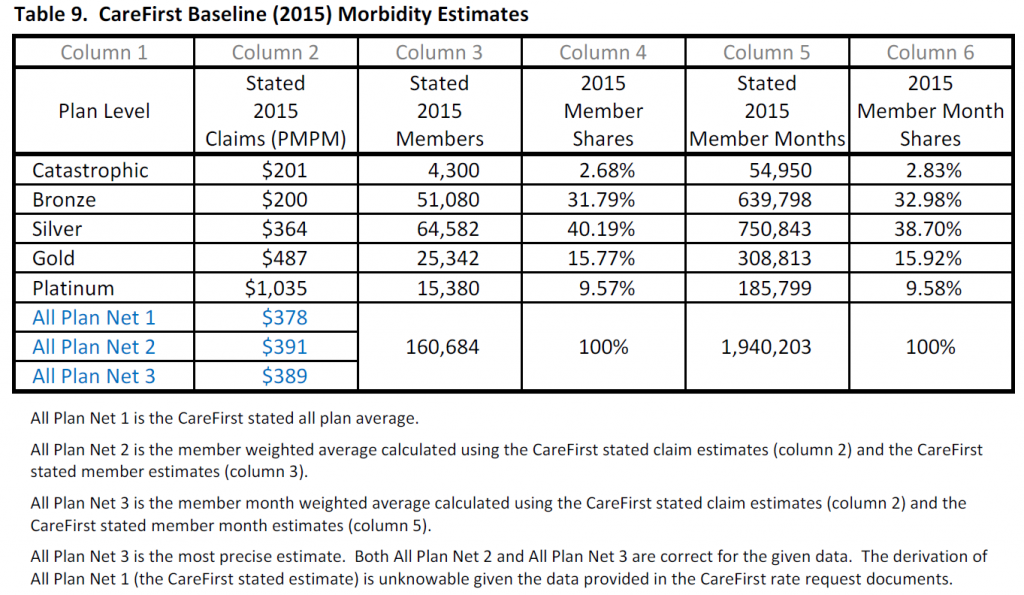
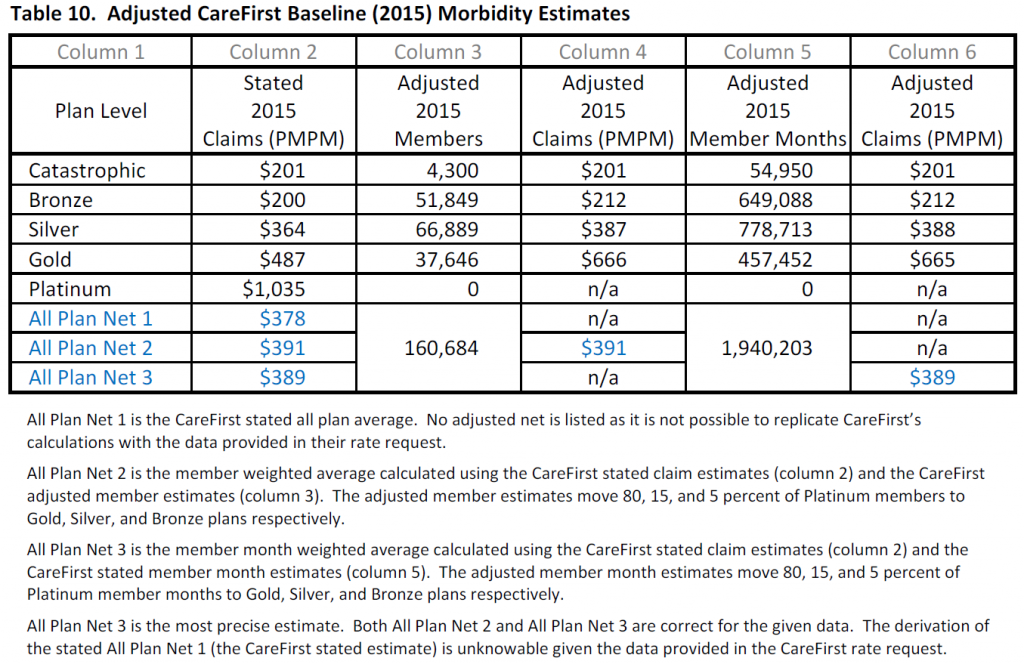
Given the presented 2015 claim data, can we get to CareFirst’s presented 2017 claim assumptions? Let’s start by looking at what the 2017 claim data would be with no change in morbidity. To estimate this data for 2017, 2015 claim data must be adjusted to redistribute terminated Platinum plan member behavior across the other available plans. In their increased morbidity filing CareFirst claims that 80 percent of Platinum members will switch to the Gold plan level, 15 percent will switch to the Silver level, and 5 percent will switch to the Bronze level plan. Why a Platinum member would drop to anything but Gold is unclear, but let’s run the numbers with the CareFirst assumption. First, however, I would also note that CareFirst’s own plan mapping data shown elsewhere in their Actuarial memorandum (page 51 of 58) assumes that all Platinum members transfer to their 2017 Silver PPO plan (via their 2016 Gold level PPO plan). I guess consistency is overrated. Nevertheless, applying the Platinum claim and member data to the other available plans in the morbidity proportions stated by CareFirst results in plan adjusted 2015 claim behavior as presented in Table 10. Note that the validity of the data adjustments is demonstrated by the constancy of the resulting all plan net claim data. In other words, redistributing the Platinum member behavior to other plans should not result in any change to the net behavioral data (if one assumes each member carries average Platinum plan behavior with them).
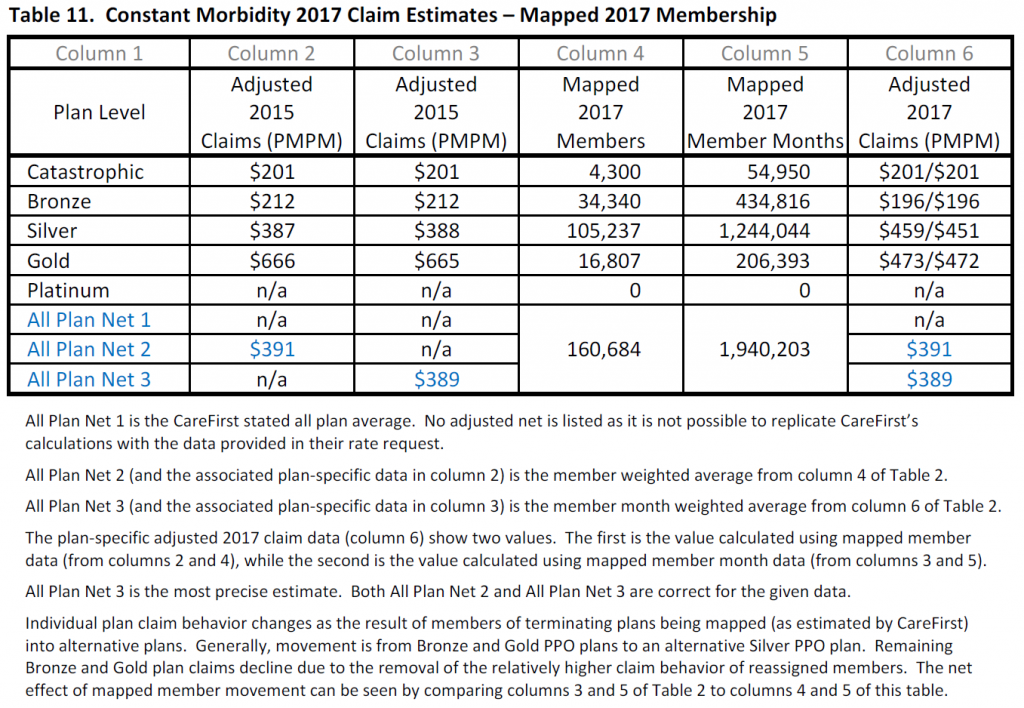
With the 2015 claim data adjusted to match the 2017 plan structure, what is the appropriate 2017 net claim behavior? Because plan membership is not assumed to be static between 2015 and 2017, developing precise estimates for this metric is somewhat difficult due to the lack of explanatory information on the assumptions CareFirst employs in their calculations. Nevertheless, some insights can be gained from data presented in the Actuarial Memorandum. The previously referenced plan mapping data presented on page 51 of 58 of CareFirst’s Actuarial Memorandum allows net constant morbidity claim behavior to calculated, while still accounting for member movement between plans. This approach assumes that total membership is unchanged between 2015 and 2017, but that member claim data is redistributed in accordance with CareFirst’s plan mapping. Under this approach, the net claim factor is unchanged from that of 2015, but plan specific factors change to reflect member (and their associated claims) movement across plans. Table 11 depicts the resulting claim factors. Generally member movement is from Bronze and Gold PPO plans to an alternative Silver PPO plan, which has the effect of moving Bronze plan members with proportionally higher claim activity than remaining Bronze plan members and Gold plan members with proportionally higher claim activity than remaining Gold plan members out of the respective Bronze and Gold plan levels and into an alternative Silver plan. Thus net Bronze and Gold claim activity decline while net Silver claim activity increases. As indicated, the net overall plan claim activity is unchanged as members and their associated claim activity are simply being redistributed among the plans offered in 2017.
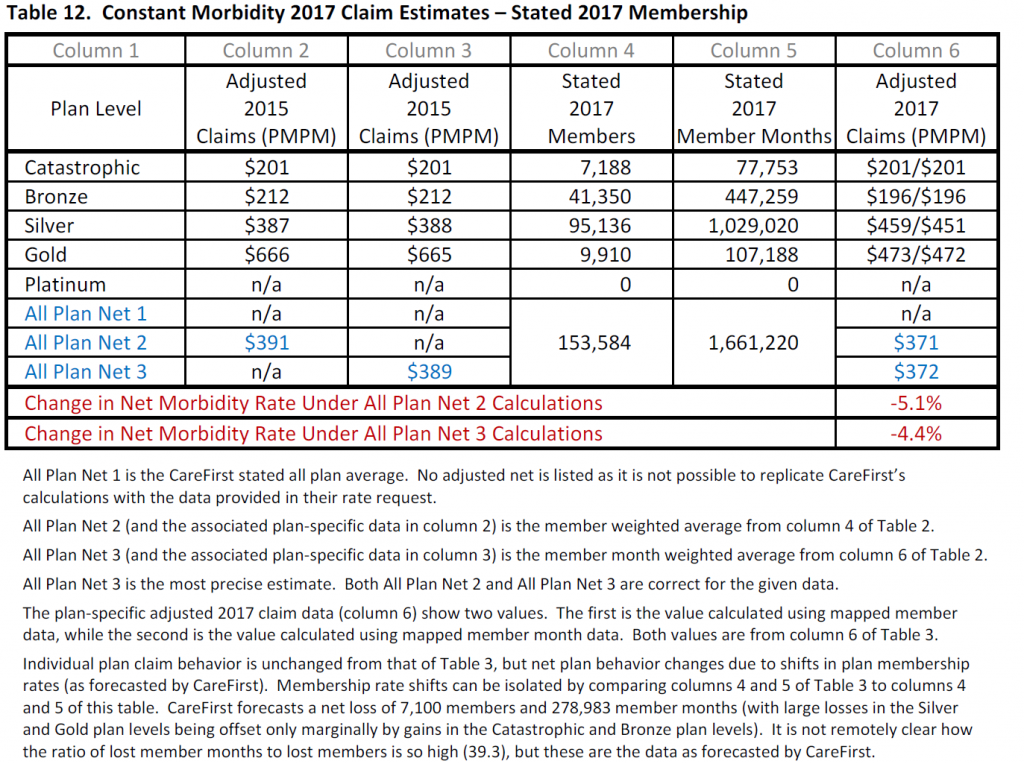
CareFirst also forecasts expected 2017 membership in their Actuarial Memorandum (page 10 of 58 for member forecasts and page 7 of 58 for member month forecasts). Remarkably, the forecasted member and member month data are consistent with regard to the membership distribution across plans. CareFirst forecasts a net decline between 2015 and 2017 of 7,100 members and 278,983 member months, with large losses in Silver and Gold plan membership being offset only marginally by comparably smaller gains in Catastrophic and Bronze plan membership. Using these forecasted membership data, it is straight forward to calculate the effect of these changes on net plan claim activity, as depicted in Table 12. The elimination of high claim Silver and Gold plan members results in a drop in net claim activity of between 4 and 5 percent. Thus, even under a constant plan specific morbidity assumption, the net morbidity of all plans combined is expected to be lower in 2017 and this is the baseline against which CareFirst should be comparing the effects of any plan specific morbidity increases.
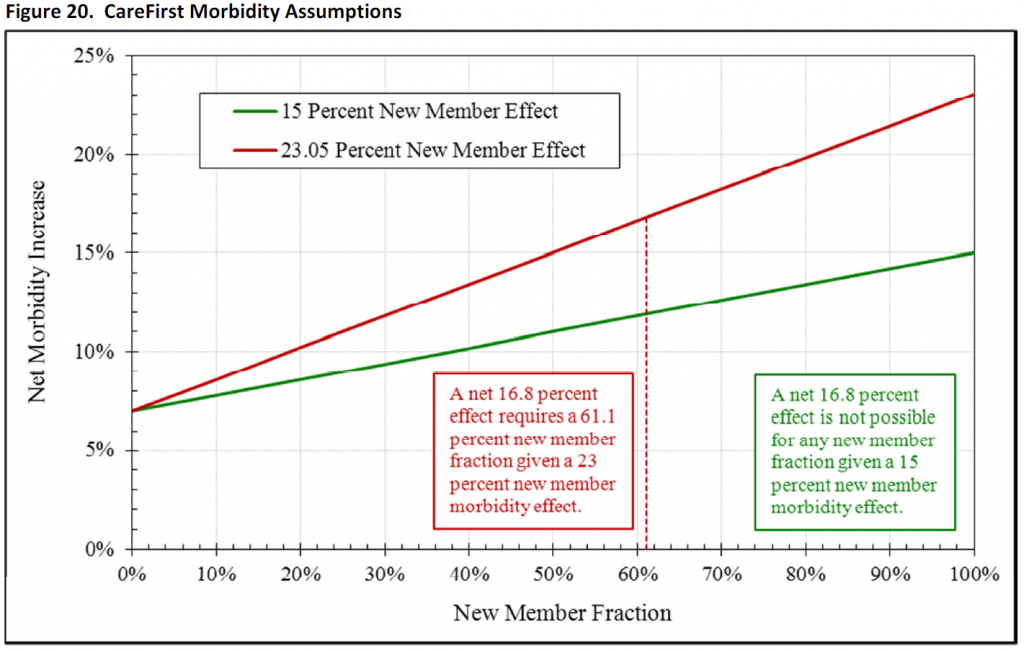
On to the meat of the matter; the assumed increase in member morbidity associated with the revised CareFirst rate request. Here, the only data that is available is the CareFirst statement that existing and new 2016 plan members are exhibiting morbidity increases of 7 and 15 percent respectively. No data is presented to demonstrate the validity of such claims, its distribution across specific plans, or with regard to what fraction of membership is assumed to be existing versus new. Since there is a net decrease of nearly 300,000 member months between observed 2015 data and forecasted 2017 data, it is not even possible to guestimate a new member fraction as there are more members leaving than joining. Nevertheless, CareFirst shows a net effect of increasing existing and new member morbidity of 16.8 percent. How a mix of members showing either a 7 or 15 percent morbidity effect can combine to generate a net effect that is higher than either individual effect is not explained (and most importantly, not possible).
If we assume (not stipulate) that CareFirst is correct and we take the CareFirst Actuarial Memorandum (page 56 of 58) literally when it states that “the demographic portion of the PLRS is being modeled in line with the morbidity (the 1.07 or 1.15 factors for existing and new)” there is no feasible new membership rate that can result in a 16.8 percent net morbidity increase. While this constraint should be obvious, Figure 20 shows that the maximum possible morbidity increase is 15 percent and that can only be achieved if every existing member leaves CareFirst before 2017 and is replaced with a new member. Even if we ignore the plain language of CareFirst and conjure up an interpretation of their statement to imply that new members exhibit a 23 percent increase in morbidity (the 1.07 existing member factor times the 1.15 new member factor would equate to a 23.05 percent morbidity increase if the two effects were cumulative), it would still require (as shown in Figure 20) over 61 percent of CareFirst’s 2017 membership to be new members. If one assumes something more realistic like a 10 percent new member rate, the maximum net morbidity increase using CareFirst’s own assumptions is 7.8 percent (or 8.6 percent under the tortured 23 percent new member effect assumption). Since overall membership is forecasted by CareFirst to decline between 2015 and 2017 it is hard to envision even a 10 percent new member increase. So how does CareFirst calculate a 16.8 percent net effect? One more example of why all of the CareFirst data must be subjected to thorough and precise validation before any rate change can be approved with confidence. There is simply no credible data provided on which anyone can base an informed decision. Even if CareFirst can demonstrate a morbidity increase, that increase should be applied against the morbidity decrease associated with the shifting CareFirst membership forecast, as presented in Table 12 above, as well as against the 4+ percent built in age based rate increase if aging effects are included in the CareFirst morbidity change analysis. In effect, CareFirst’s rate request should be able to accommodate between a 5 and 9 percent morbidity increase with no negative rate effects.
Revised Part 5 Charts. To provide a complete view of the impact of revised rate request, it is appropriate to update the key charts included in my Part 5 comments. Firstly, Figure 21 presents a summary of the original and revised rate requests on a plan specific basis. The revised requests essentially amount to an additional 11 to 17 percent rate increase layered on top of the rates requested only one month earlier. As with the original request, the highest requested revised rate increase is for one of only two plans that exhibit a payout ratio below 90 percent. CareFirst’s own data show that the Bronze level plan slated for a 63 percent premium increase, exhibits a staggeringly healthy payout ratio of 59 percent. Figure 22 presents a summary of the payout ratios that would be expected if CareFirst’s morbidity assumptions are flawed and their requested rates are nevertheless approved. Note the Bronze plan payout ratio of 33 percent.
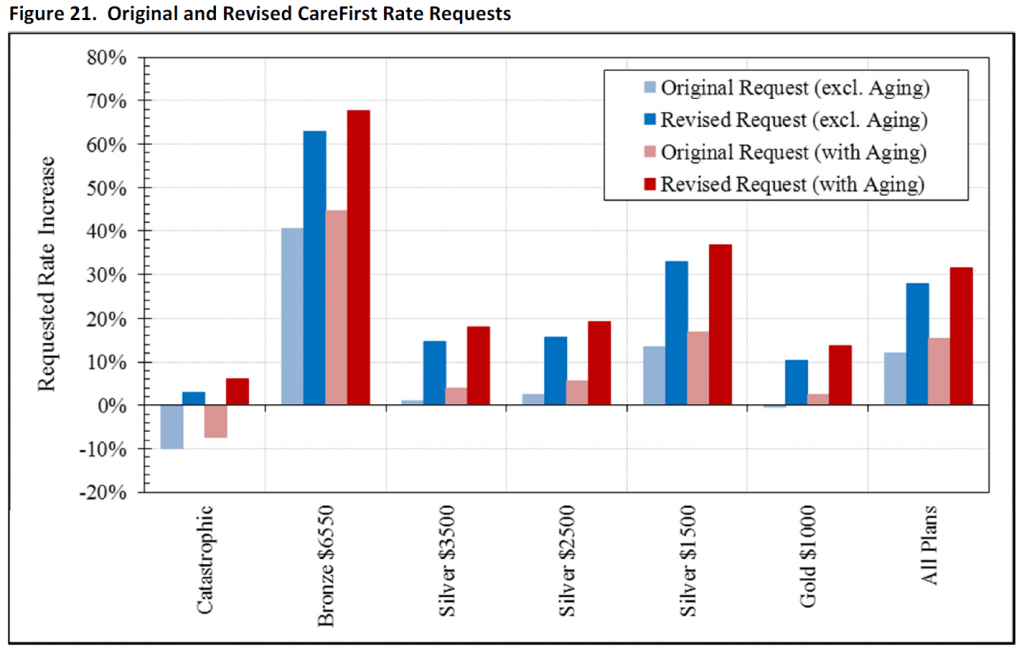
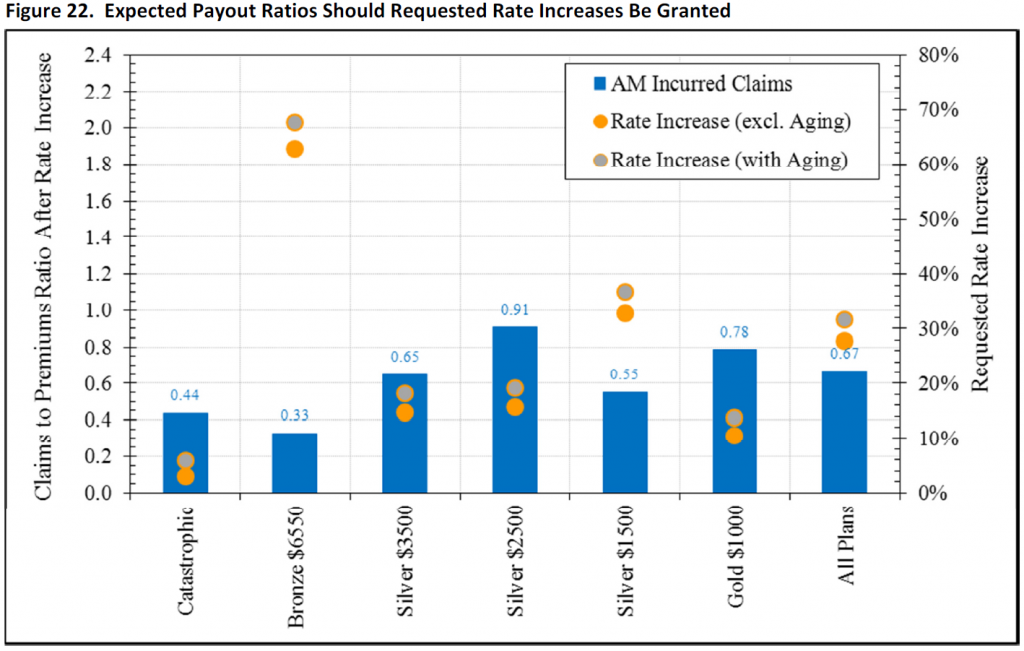
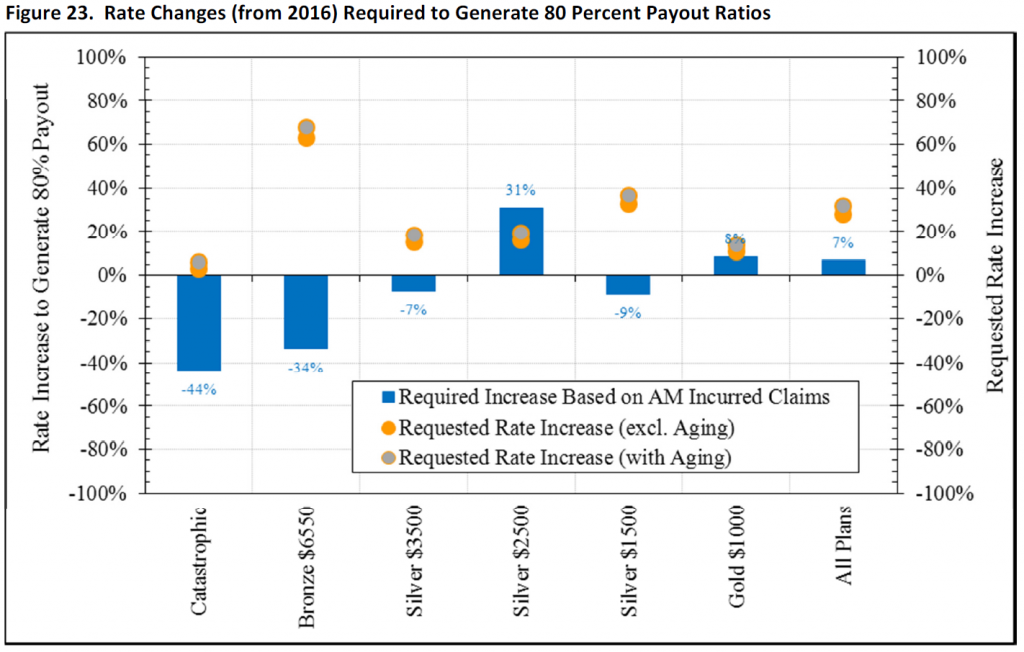
Figure 23 presents the rate changes required to produce a full slate of 80 percent payout ratio plans. Catastrophic and Bronze plan members should be granted substantial rate decreases from those approved for 2016. Although CareFirst originally proposed a modest rate decrease for Catastrophic plan members, even that is now gone. Similarly, instead of a reasonable 30+ percent rate decrease, Bronze plan members are targeted for a 60 to 70 percent rate increase. This increase serves only a single purpose; to subsidize Silver $2,500 plan members, who merit a 30 percent rate increase, but are targeted for only about half that.
As stated in my Part 5 comments, the underlying cause of the poor plan specific outcomes is reliance on a fatally flawed rate review methodology that does not correct for either previously mispriced plans or the behavioral influence of ACA cost sharing. Moreover, since the ACA imposes no controls to address the varying treatment thresholds of individuals, there is no incentive to reward economically efficient behavior or penalize economically inefficient behavior. The net effect is that premium money flows from responsible consumers to irresponsible consumers, even when both have the same access to care and are subject to the same symptoms.
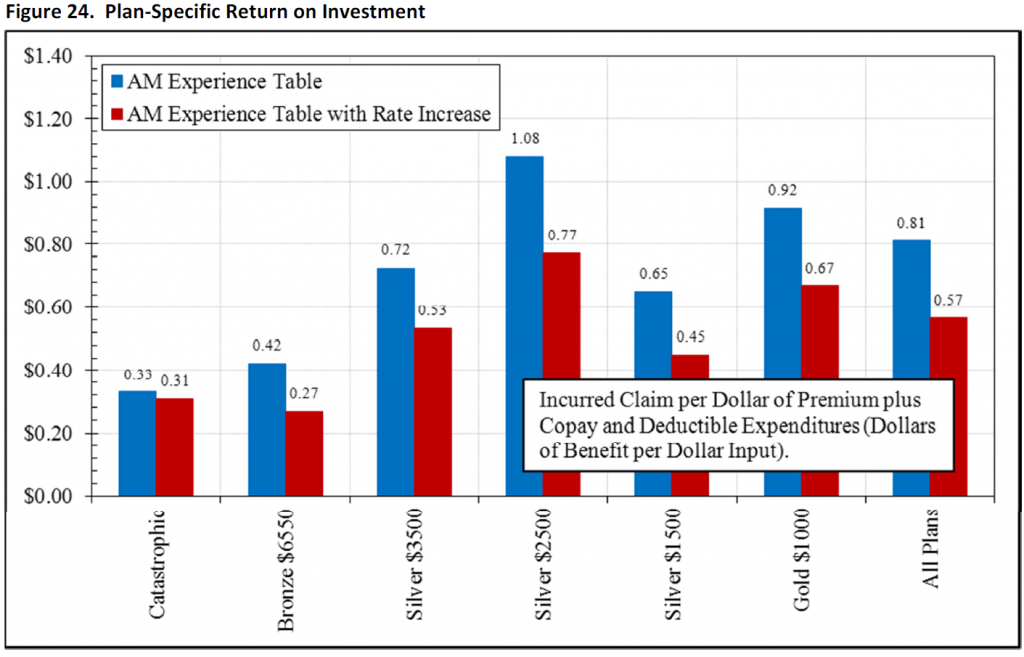
Figure 24 presents plan specific returns on investment with and without the requested rate changes. This data shows dollars of incurred claim per dollar of out of pocket cost paid (premiums plus co pays); in other words dollars of benefit received per dollar paid into the system. As shown, Catastrophic and Bronze plan members receive benefits equal to only about one third of their payments. Silver plan members receive $0.60-$1.10 in benefits per dollar spent, and Gold plan members receive about $0.90 on the dollar. It is obvious who is paying the freight. The design actuarial values of the plans differ by roughly 14 percent between Bronze and Silver (actuarial values of 60 versus 70 percent respectively) and 25 percent between Bronze and Gold (actuarial values of 60 versus 80 percent respectively) level plans. Properly priced plans should roughly reflect this same economic differential so that consumers are not artificially attracted to, or behaviorally influenced by, any given plan. Instead, the historic plan data show about a 40 percent value differential between Bronze and Silver level plans (using $0.70 returned per dollar spent for Silver based on the fact that the Silver $2,500 plan is affected by the incorporation of historic Gold level plan members) and a 55 percent value differential between Bronze and Gold level plans. Therefore, although the plan actuarial values as defined by the ACA may indeed be accurate (since the ACA definition does not consider the premium cost of a plan), the historic premiums charged for these plans were not. Thus it is virtually certain that actual claims were greater than those that would have accrued in a properly priced system. Of course, under the ACA rate review process, higher than nominal claims in any plan equate directly to higher premiums for all plans.
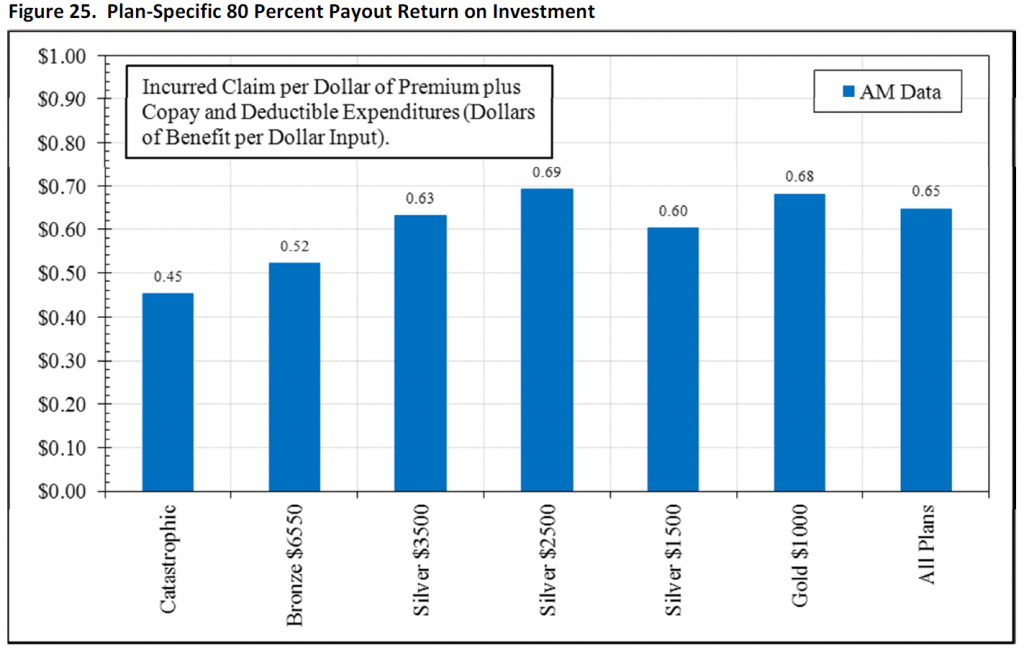
As shown in Figure 23 above, it is possible to set plan specific premiums on the basis of individual 80 percent payout ratios. If such an approach was implemented, the per dollar expended benefits by plan can readily be calculated, as presented in Figure 25. These estimates compare directly with the historic data presented in Figure 24. What is immediately apparent is that the differences in plan specific returns are almost exactly in line with the differing actuarial values of the plans. Bronze plan members receive a 10-19 percent lower return than the average Silver plan member, and a 24-25 percent lower return than a Gold plan member. Unfortunately, the rates are still affected (to the high side) by historic design issues, but future additions to the effects already incurred can be curtailed. To accomplish this, it is imperative that rates be established on an independent plan specific basis, not an interdependent aggregate plan basis.
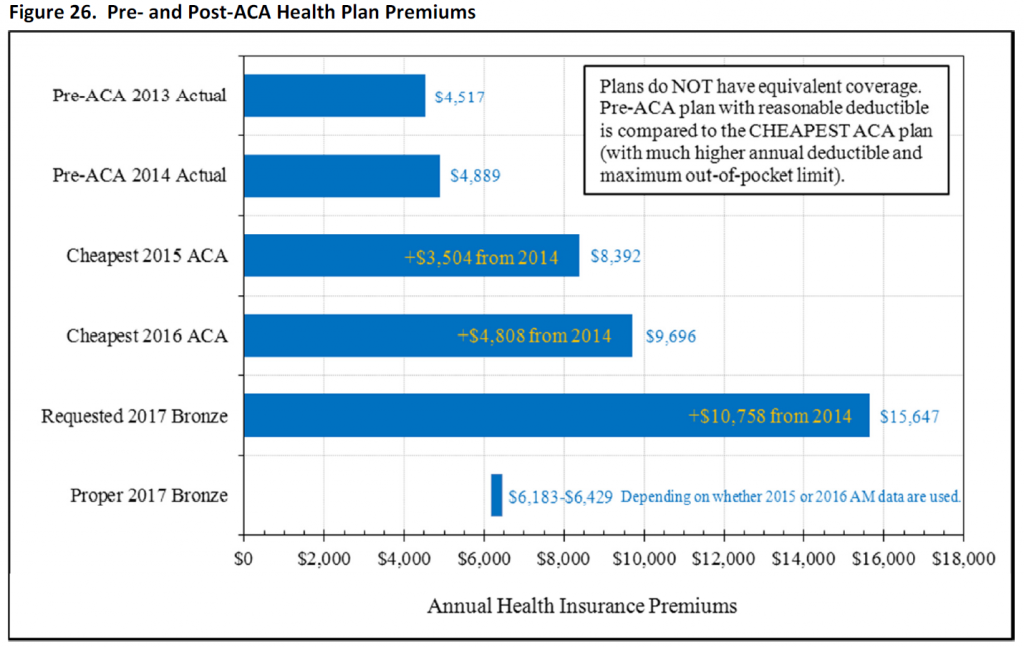
Finally, Figure 26 depicts the annual premiums associated with the pre-ACA plan for my family versus the cheapest premiums available for ACA plans. If the Bronze level premium increase for 2017 is approved as requested, plan premiums alone will have more than tripled over a three year period; for coverage that is substantially inferior to that under our pre-ACA plan (e.g., annual out of pocket maximums of $29,000 ACA versus $10,000 pre-ACA). The 2017 ACA premiums alone would represent 19.5 percent of annual gross income for a family of three making four times the 2016 Federal Poverty Level. The maximum annual out of pocket expenses for the plan would constitute 35.8 percent of that same income.
Editorial Thoughts. While I will defer repeating the editorial comments included in my Part 5 and Part 6 comments, I will add the following thoughts that I believe should be addressed in any rate approvals issued in response to CareFirst’s request. Some (or all) of these issues may be better addressed as part of the larger ACA process, but since it is apparent that no one who has any control over that process is concerned, I will raise them here.
Administrative cost control. Since insurer administrative costs are constrained under the ACA only as a fraction of premiums, every rate request submitted by CareFirst (or any other provider) includes an inherent administrative budget increase. In effect, 20 percent of every dollar of rate increase is allocated to the insurer’s operational costs regardless of whether their administrative costs are rising, falling, or unchanged. Clearly there is no incentive for the insurer to control such costs. In 2015, CareFirst collected $535 million in individual marketplace premiums, placing their administrative costs at roughly $107 million. For their 2016 approved rates, CareFirst should collect about $668 million in individual marketplace premiums, of which $134 million is allocated to administration. Thus, CareFirst reaps an associated administrative budget increase of $27 million, an increase of about 25 percent from 2015. If the CareFirst 2017 rate increase is approved as requested, they should collect about $854 million in individual marketplace premiums in 2017, with an administrative share of $171 million. This reflects an administrative budget increase of $37 million over 2016 and $64 million over 2015, for a net increase of 28 percent over 2016 and 60 percent over 2015. Moreover, the revised 2017 rate request (relative to the original 2017 rate request) would result in an additional $21 million allocation to CareFirst’s administrative budget even though the only effective change between the two requests is increased morbidity. Where does this money go and why is it even considered to be appropriately allocated? Clearly this is a windfall for CareFirst (and other insurers) and a perverse penalty passed to consumers for which they receive no benefit. There is absolutely no reason that administrative costs should scale with premiums. This perverse incentive should be eliminated immediately.
How are double (and approaching triple) digit premium increases consistent with declining health care costs? Somehow we are in the midst of a period where the increase in health care costs is purported to be at low single digit levels and yet individual market health care premiums and deductibles are skyrocketing. How can this be? I can certainly speculate with regard to the reasons, and to the extent possible given available rate request data have provided partial insights into potential causes in my comments, but clearly there is a large problem here that must be addressed – and which can only be addressed by those with access to the underlying data. Unfortunately, those with such access either have no incentive to provide an explanation (for the very reasons alluded to in the previous discussion) or simply don’t care. This is precisely why average Americans are losing faith in their representatives and even this is not sufficiently obvious to generate concern among those parties.
Where, oh where, are the emergency room savings? My favorite ACA rhetoric; if we just get folks out of the emergency rooms and into the regular health care system, we’ll save a bundle. Well, that bundle must be lost in transit. Without question, whatever inordinate emergency room and other medical care costs were incurred prior to the ACA were being passed on to consumers at that time. Thus, the medically underwritten health insurance rates in effect prior to the ACA must have included these inordinate pass through costs. Yet given a tripling of premiums (and a near tripling of deductibles) since the passage of the ACA, those pass through costs were not even close to being sufficient to cover either the latent treatment demand that existed prior to the ACA or the additional demand that the ACA has induced. Since the ACA includes no premium (or deductible) cost containment provisions, what is the strategy to introduce critically needed cost and behavioral constraints? If folks really think the individual ACA market is healthy, then I propose a simple experiment; namely, require all Americans regardless of employment to obtain coverage through the individual market without any employer or government subsidies other than those offered routinely through the individual market. Of course, this will never happen as those of us forced to pay full fare in this market constitute an insignificant power base, but those that have the responsibility to develop and administer this program should make every decision as if they were subject to the same market requirements that they hold up as fair and effective. Anything less is unacceptable.
On August 15, 2016, the Maryland Insurance Administration held a public hearing on the revised 2017 individual market rate requests. My statement at the hearing is presented as Part 8 of this saga …
Posted September 1, 2016Questions or comments can be sent to aca@meszler.com